The vents are blowing warm air on a hot afternoon, and there is a sleeve of ice on the fat copper line, or the indoor coil has turned into a white block. The ice is a symptom. The system is not dead, and the cause is usually cheap. What you do in the next few minutes decides whether it stays cheap.
- Coil temperature at which the moisture in the air starts to freeze on it
- 32°F
- Where a working evaporator coil normally runs
- ~40°F
- Thaw time with the cooling off and the fan on
- 1–4 hr
- Refreezing this fast with a clean filter points at refrigerant
- 24 hr
Coil temperatures and pressures as HVAC technicians read them in the field; repair prices from HomeAdvisor's 2026 national data.
Turn the cooling off before anything else
Set the thermostat to OFF, or turn the cooling down so it stops calling, and switch the fan from AUTO to ON. The blower keeps pushing warm house air across the coil without the compressor running, and that is what melts the ice.
Do this first because the compressor is at risk while the coil is frozen. Refrigerant is supposed to arrive at the coil as a liquid and leave as a gas. With ice blocking the air, it cannot pick up enough heat to boil, and liquid can flow back to the compressor. A compressor squeezes vapor; a slug of liquid can bend its valves. Technicians pull the outdoor disconnect before they diagnose a frozen system for the same reason.
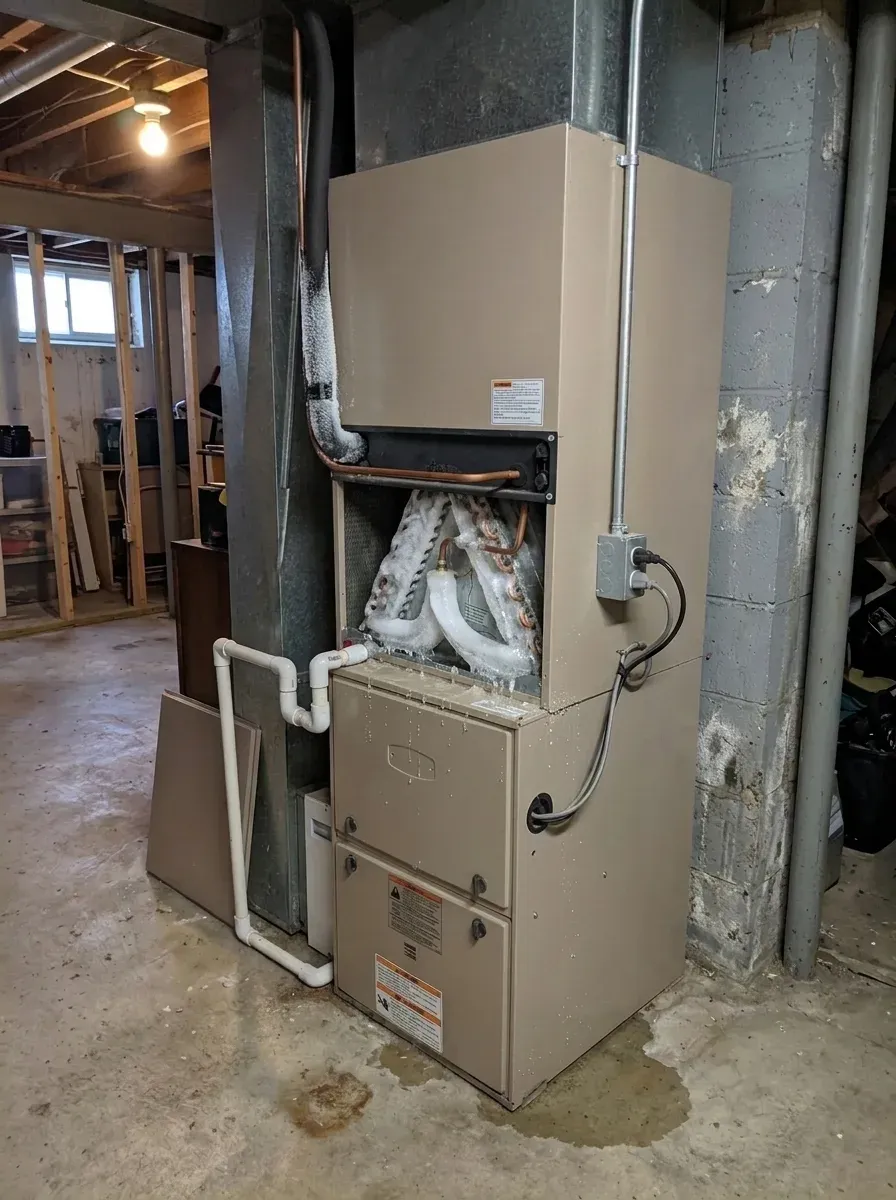
While it thaws:
- Put towels down. Meltwater from a heavy block overflows the drain pan and runs down the side of the furnace or air handler.
- Leave the ice alone. The coil is thin aluminum fin over soft copper tube. A screwdriver through it is a refrigerant leak, and a heat gun or hot water can crack it.
- Wait for bare metal. The ice itself blocks airflow, so any check done on a half-frozen coil gives false answers.
How a coil gets below freezing
A refrigerant’s boiling temperature follows its pressure. Charged correctly, the coil runs at roughly 40 to 50°F, cold enough to pull heat and humidity out of the air and warm enough that the water it condenses drips into the pan instead of freezing. To freeze, the coil has to drop under 32°F, and only two things do that:
- Not enough warm air crossing it. The refrigerant keeps absorbing cold with nothing to warm it, and the coil temperature sinks. This is the common one.
- Pressure in the coil too low. Either there is not enough refrigerant in the system (a leak), or something is blocking its flow into the coil (a restriction).
A technician reads this on a gauge. On an R-22 system, about 75 psi on the low side corresponds to a coil near 45°F; let it fall to around 55 psi and the coil sits near 30°F, where ice builds. An R-410A system runs at higher pressure, roughly 130 to 150 psi on the low side on a warm day, and the newer R-454B a little lower, about 120 to 140.
Airflow checks, in the order that finds the fault fastest
Do these after the coil has thawed, with the filter slot and the air handler panels within reach.
The filter. Pull it and hold it up to a window. A filter that blocks the light is enough to explain the ice. Look for the two cases that freeze coils most often: a filter so loaded it has collapsed and been sucked flat against the coil, and no filter at all, which lets dust and pet hair coat the coil directly. “I changed it recently” does not mean it is clean: drywall sanding, painting or two shedding dogs can plug one in weeks.
Registers and returns. Walk the house. Supply registers closed in half the rooms, or a sofa or rug over a return grille, starve the coil just like a dirty filter. Return grilles have no damper, and covering one because it “blows the wrong way” will freeze the coil within a day or two.
The blower itself. With the cooling calling, go to the air handler and confirm the blower wheel is turning. Do not judge by putting a hand to a vent: a frozen coil blocks the air, so a running blower can feel like no air at all.
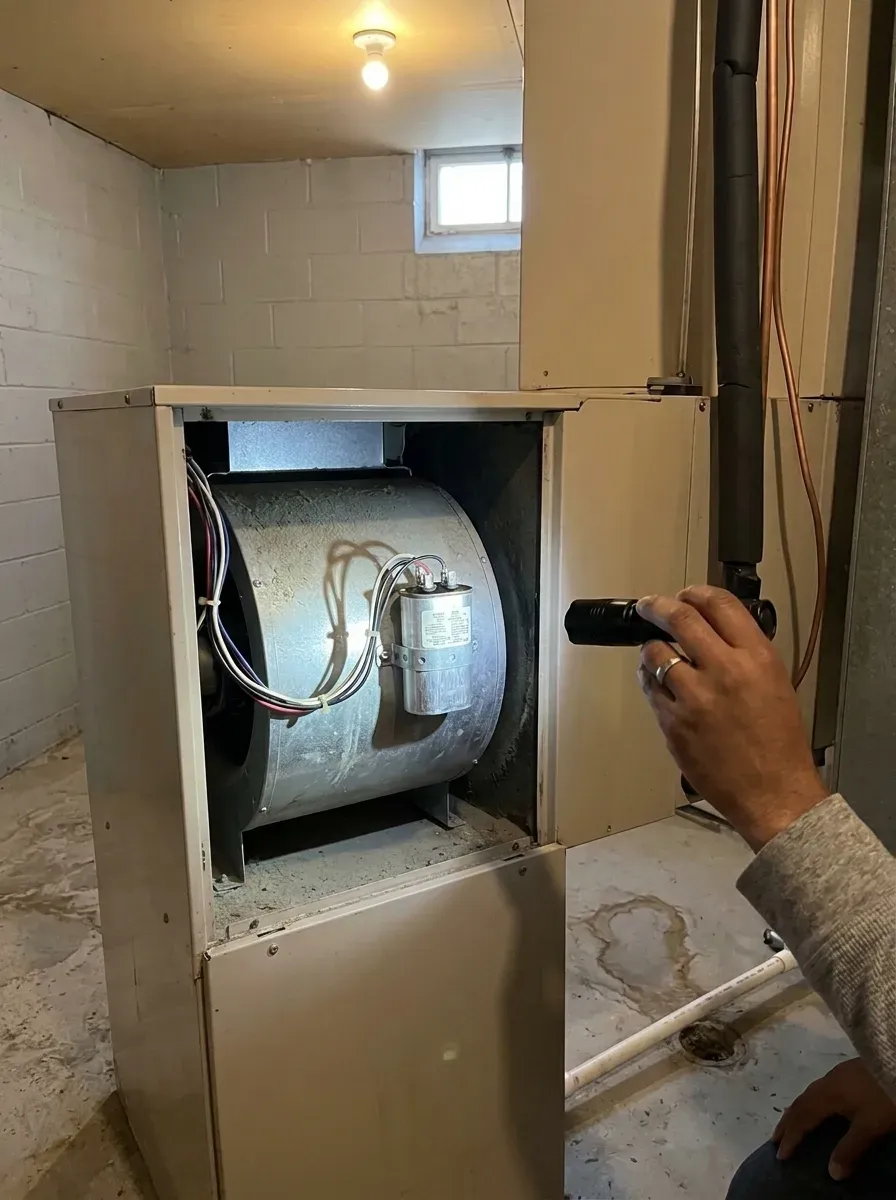
A blower that does not start points to the thermostat signal, the motor or its capacitor, or on a variable-speed motor, the control board or module. A blower that turns but slowly is the trap: a failing run capacitor keeps the motor going at reduced speed, so the system looks normal and still freezes. Both are jobs for a technician, because the capacitor holds a charge after the power is off.
The coil. If the filter has been missing or bypassed for a while, the underside of the coil collects a felt of dust that acts like a filter you cannot remove. On many furnaces the coil sits in a cased box above the burner, with a cover plate held by a few screws.
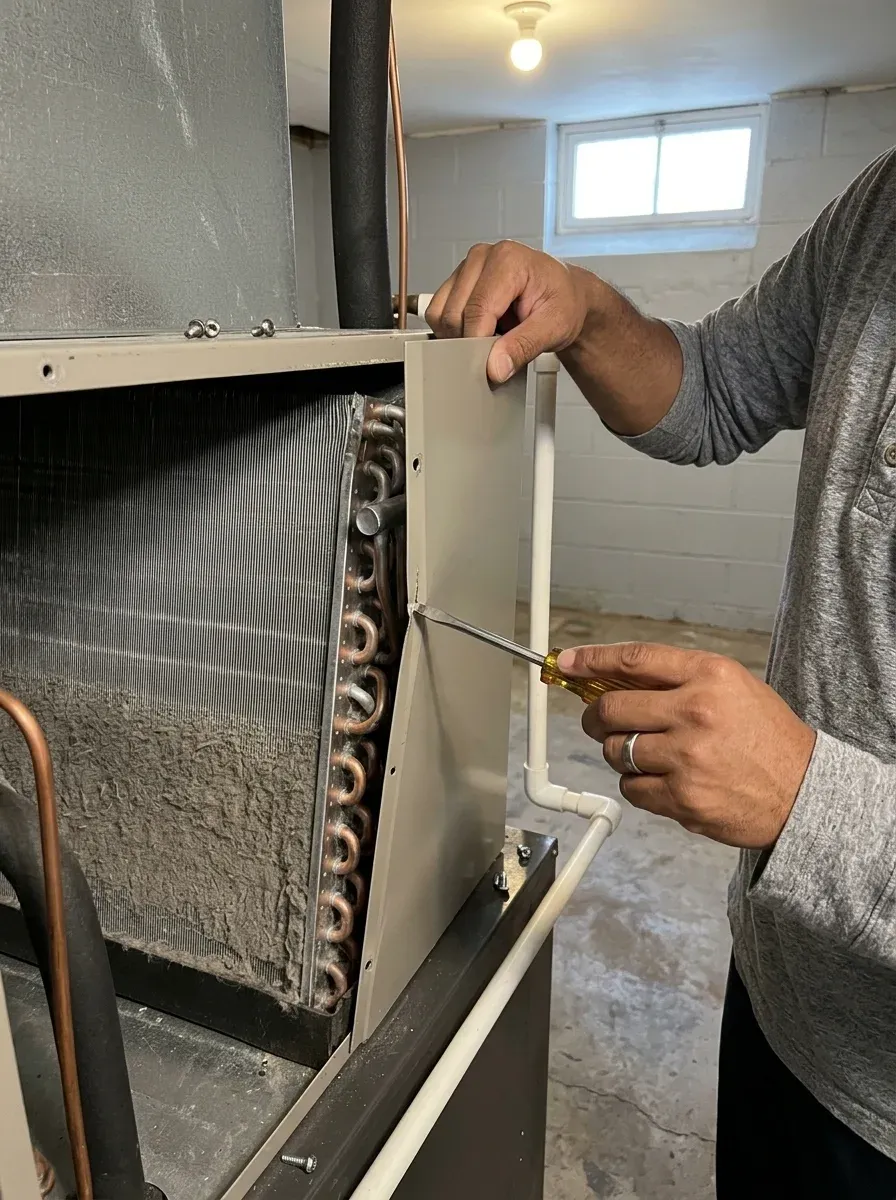
Vacuum in the same direction as the fins, never across them, and do not force the coil or bend the copper lines to get more room: a kinked line is a much bigger repair than a dirty coil. A foaming no-rinse cleaner finishes the job, and the condensate the coil produces washes it into the drain pan. If the coil sits in a sealed plenum with no access panel, have it cleaned by a technician.
AC Not Cooling? 7 Causes and How to Fix Each (2026) Ice is one of seven reasons an AC runs without cooling. The other six are in the main diagnostic guide.When it freezes again, read the timing
How fast it comes back, and when, narrows the cause.
A system running in cool weather, or driven to a very low setpoint, has too little heat coming off the air to keep the coil above freezing. An oversized unit cools the rooms so quickly that it short-runs and never dries the air; in humid weather that combination can frost the coil while the house feels damp.
The refrigerant-side causes a technician tracks down
Once airflow is ruled out and the coil has fully thawed, the technician connects gauges and reads both sides of the system with the cooling running. The pattern separates the last three causes.
- Both pressures low: the system is short of refrigerant. Refrigerant is not burned off or used up, so a low charge means a leak. Technicians often find them at the indoor coil, less often at the outdoor unit’s service valves or where a nail has gone through a line set.
- Very low suction with very high head pressure: something is restricting the flow. A kinked line is possible but rare. A plugged filter drier, the small canister on the liquid line, shows up as a temperature difference between its two ends.
- Low suction that recovers when the valve’s sensing bulb is warmed: the expansion valve is closing too far.
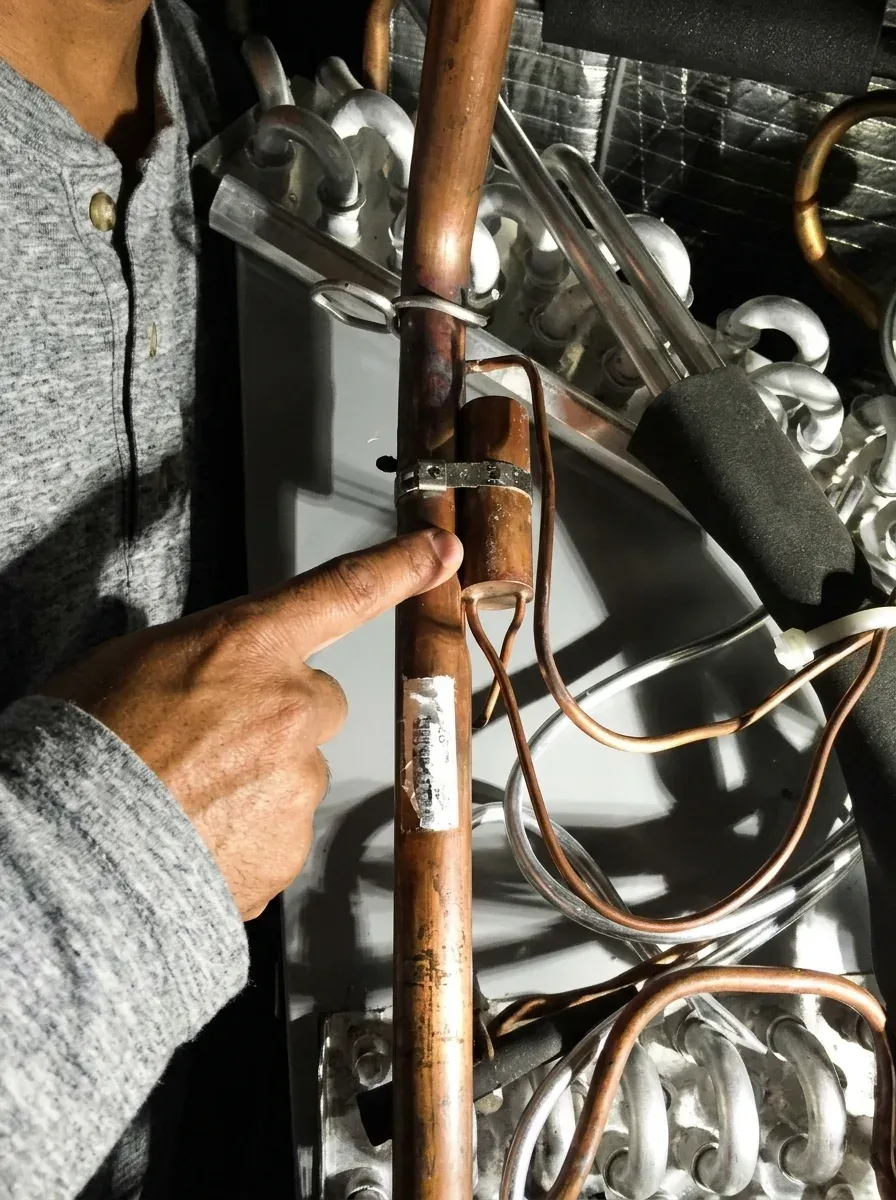
The thermostatic expansion valve meters refrigerant into the coil based on what its sensing bulb feels on the suction line. If the bulb is mounted inside the coil cabinet without its insulation, the cold air reads as a cold line, the valve throttles down, pressure drops and the coil freezes, with a full charge. Technicians test it by warming the bulb by hand and watching the pressures come back up.
Do not let a frozen coil sell you a new system
A frozen coil is one of the most common summer calls, and one of the easiest to oversell. If the first visit ends in a replacement quote before anyone has checked the filter, the coil, the blower speed and the pressures, get a second opinion. Sometimes the compressor really is failing or the system is near the end of its life, and that is a fair conversation. It belongs after the cheap causes have been ruled out, with the readings to show for it.