You look out on a cold morning and the heat pump is white with frost. Sometimes that is exactly what it should look like. Sometimes it is a block of ice that will take the fan motor with it. The difference is easy to see once you know what to look for, and one question sorts out most of the rest: does the unit go into defrost, and does the ice clear when it does?
- Run time between defrost cycles, set on the defrost board
- 30–90 min
- Longest a defrost cycle runs before the control ends it
- 10–14 min
- Clear space one manufacturer requires above the outdoor fan
- 48 in
- National average heat pump repair in 2026
- $410
Sources: Lennox HP26 and Rheem heat pump installation manuals, HomeAdvisor national cost data (June 2026).
Is your heat pump frozen, or just frosted?
In heating mode, a heat pump pulls heat out of the outdoor air and moves it inside. To do that, the outdoor coil has to run colder than the air around it. On a damp day anywhere near freezing, the moisture in the air freezes onto the fins, the same way frost forms on a car windshield.
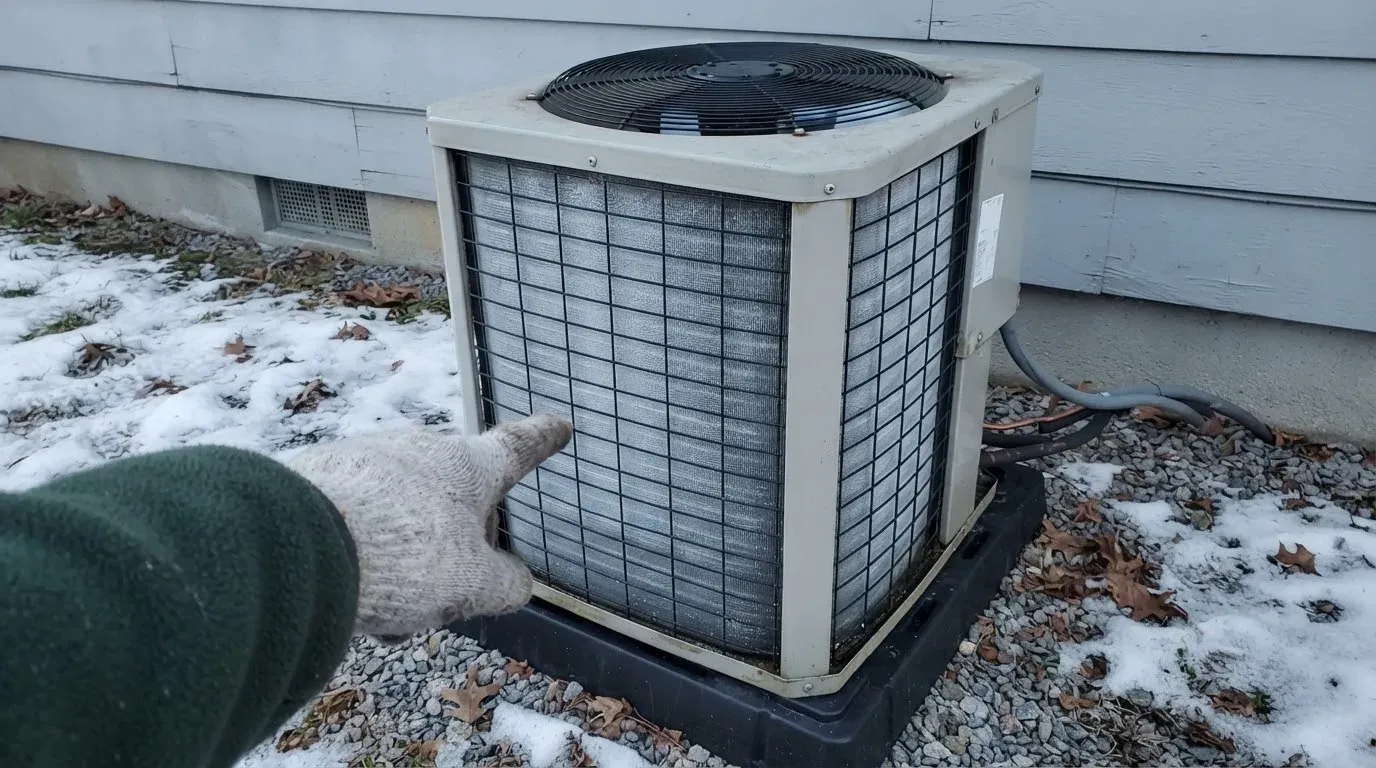
The unit expects this. A defrost control counts compressor run time and checks a sensor on the coil. After 30, 60 or 90 minutes of running with a cold coil (many ship set to 90), it starts a defrost cycle and melts the frost off. Rheem’s homeowner manual says it plainly: the coat of snow and ice is “normal, and the unit will periodically defrost itself.”
So the question is not whether there is frost, but how much and whether it goes away:
- Thin frost, fins still visible, gone after a defrost: normal.
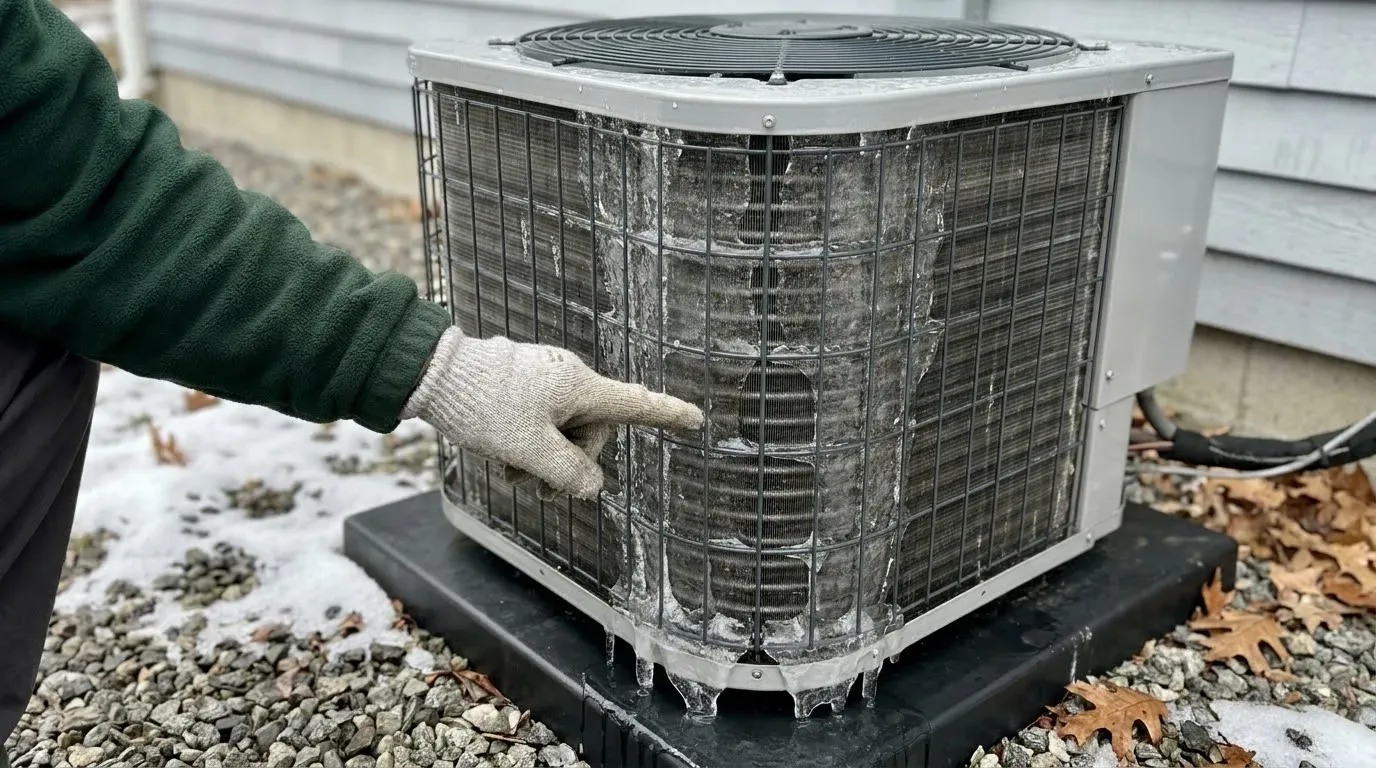
- Thick ice that hides the fins, or still there after an hour and a half of running: a fault.
- Ice building up from the bottom, around the base and the drain holes: a water or drainage problem.
- Ice on the fan blade, the top grille or the whole cabinet: turn the unit off now (see below).
What a normal defrost cycle looks and sounds like
Defrost scares people who have never watched one, so it helps to know what to expect. When the cycle starts:
- The outdoor fan stops. The compressor keeps running.
- You hear a loud whoosh as the reversing valve switches the system into cooling mode for a few minutes. Hot refrigerant now runs through the outdoor coil instead of the indoor one.
- The frost melts, water runs out of the bottom of the unit, and steam rises off the warm coil. With the fan stopped, it can look like the unit is smoking. It is not.
- Indoors, the backup heat strips come on so the vents do not blow cold air. On a ductless mini-split, the indoor fan simply stops until the defrost is over.
- When the coil sensor reads warm again, or after a fixed limit (10 minutes on some Rheem units, 14 on some Lennox units), the valve switches back with another whoosh and the fan restarts.
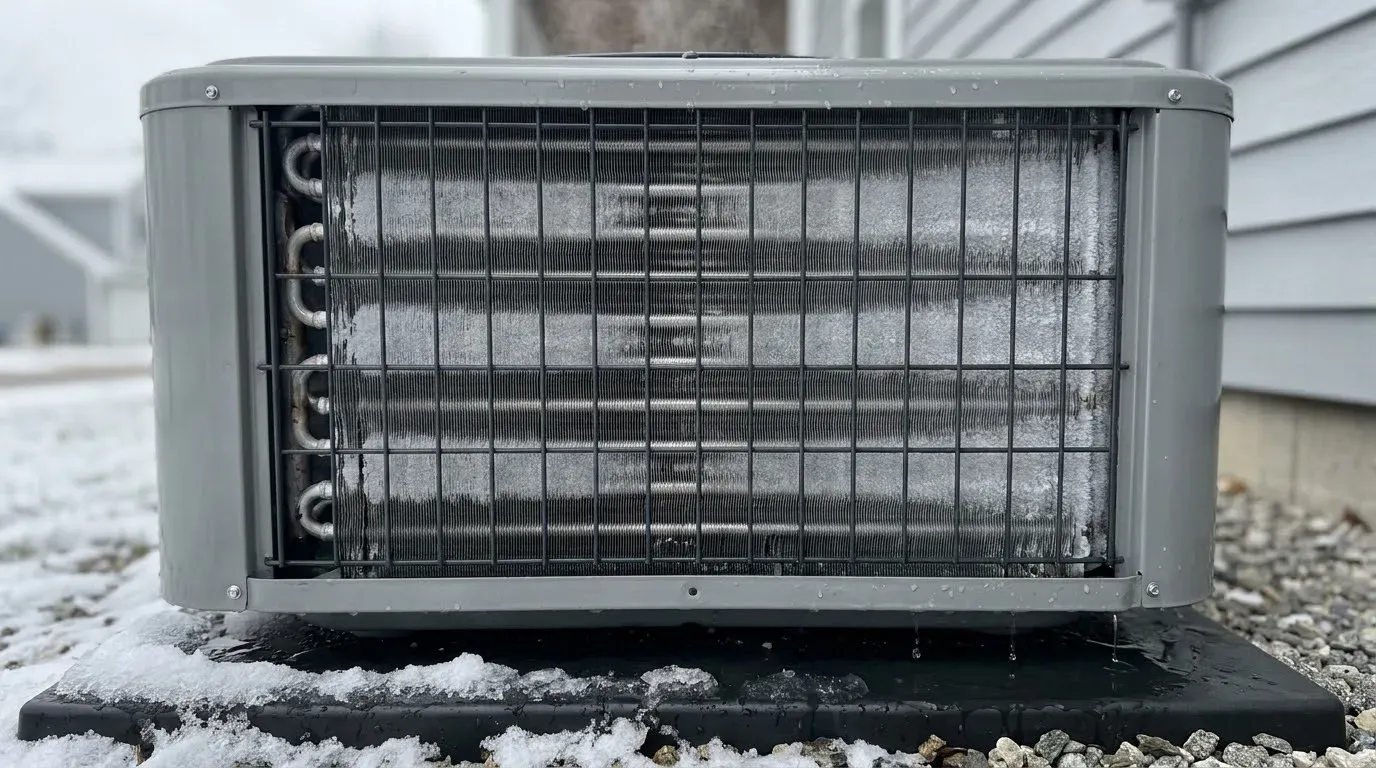
If you see that sequence and the coil comes out clean, the system is working. If you see it and the coil comes out still white, or you never see it at all, you have narrowed the fault down a long way. The table further down sorts it out.
What to do right now if it is a block of ice
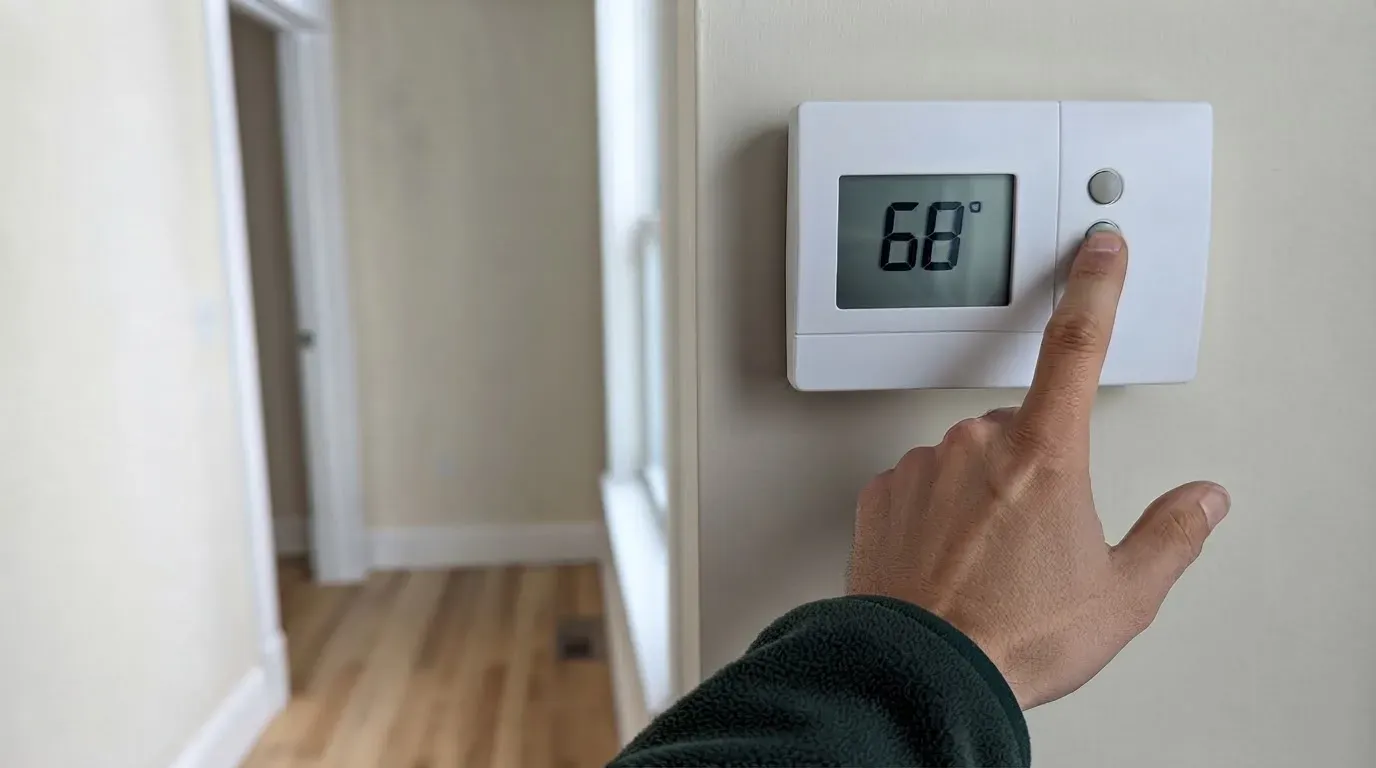
Switch the thermostat to emergency heat. It is often labeled EM HEAT or EMER. That locks the outdoor unit off and runs the house on the backup electric heat. The point is to stop the outdoor fan from spinning into ice, which can bend the blade and burn out the motor, while still keeping the house warm. Rheem’s manual describes the setting as a backup “to be used only if there is a suspected problem with the outdoor unit,” and that is the right way to treat it: electric resistance heat costs much more to run than the heat pump does, so it is a stopgap until someone has looked at the unit.
If your thermostat has no emergency heat setting, or the house has no backup heat, turn the system off at the thermostat and let the unit thaw.
Do not chip at the ice. The fins and the tubes behind them are thin aluminum and copper, and a screwdriver or an ice scraper punches a refrigerant leak into a coil that may have had nothing wrong with it. Leave the unit off and let it melt on its own.
Then look at what is around it. While it thaws, the next two causes are the ones you can check and fix yourself.
The causes, in order
Is something blocking the air around the unit?
A heat pump needs to pull a lot of outdoor air through its coil, and it needs that air to be fresh. Snow drifted against the cabinet, leaves packed into the fins, shrubs grown in close, a deck or a fence too near: all of them cut the airflow, and a coil that gets less air runs colder and frosts faster than the defrost control is set to handle.
The less obvious version is recirculation. A unit tucked into a narrow side passage, between a house wall and a fence, blows its cold, dry exhaust air into a dead end, and that air swirls back into the intake. The coil then works on air that is already colder than the outdoors, so it ices up quickly and defrosts again and again. A unit that frosts over and goes into defrost every half hour, while a neighbor’s in open ground does not, is often just installed in the wrong place.
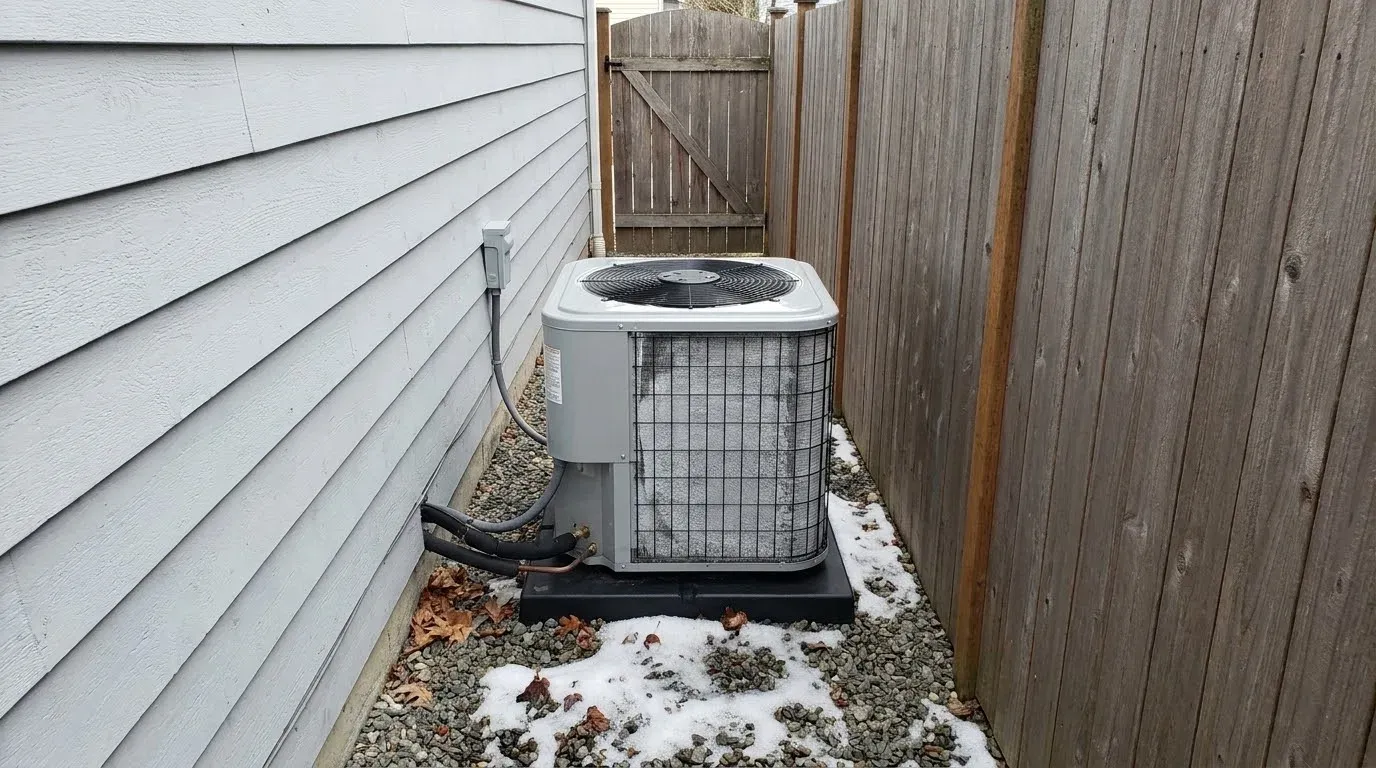
Clearances vary by model, so the installation manual for your unit is the final word. As an example, the Lennox HP26 manual asks for 36 inches on the service side and on one other side, 12 and 6 inches on the remaining two, and 48 inches above the fan. Use those as a rough guide:
- Clear snow from around and on top of the unit after every storm, by hand or with a broom. Not a shovel against the fins.
- Pull leaves and grass clippings out of the coil with the power off at the disconnect.
- Cut shrubs back so there is open space all around.
- Do not cover the unit with a tarp or a box for the winter. A heat pump runs all winter; an air conditioner cover belongs on an air conditioner only.
If the unit itself is in the wrong spot, the fix is moving it, which is an HVAC job but sometimes the only real cure.
Is water dripping onto it or pooling under it?
When ice starts at the bottom and works up, or sits in one thick patch on one side, look at where the water is coming from.
From above. A gutter that overflows, a downspout that drains onto the unit or a roof edge that drips meltwater straight onto the coil will freeze there faster than any defrost cycle can clear it. Manufacturers tell installers to keep units away from overhanging rooflines for exactly this reason. Clean the gutter, extend the downspout, or add a short diverter so the water lands somewhere else.
From below. Every defrost cycle drains water out of the base of the unit. If that water cannot get away, it refreezes into a growing shelf of ice under the coil, which then blocks the next defrost. The unit should sit on a pad or feet high enough to stay above standing water and above the average snow depth where you live, and the pad should slope away from the house. A unit that has sunk into the ground, or sits on a pad tipped toward the wall, needs to be raised and leveled.
Is the outdoor fan running?
Outside a defrost cycle, the fan on top should be spinning whenever the compressor is running. If the compressor hums and the fan sits still, the coil gets no air at all and turns to ice within minutes. The usual cause is a failed fan motor or the capacitor that starts it.
Both are line-voltage parts behind the panel, and the capacitor holds a charge after the power is off. This is a call. Nationally, HomeAdvisor’s data puts a fan motor at $250 to $650 installed and a capacitor at $150 to $250. A blade bent by ice is another $150 to $400.
Does it ever go into defrost?
If the unit has been running for more than an hour and a half, it is a solid block of ice, and you have never heard the whoosh or seen the fan stop, the defrost system is not starting the cycle. The control has two parts that can fail: the defrost board, and the sensor or defrost thermostat clipped to a tube on the coil that tells the board the coil is cold.
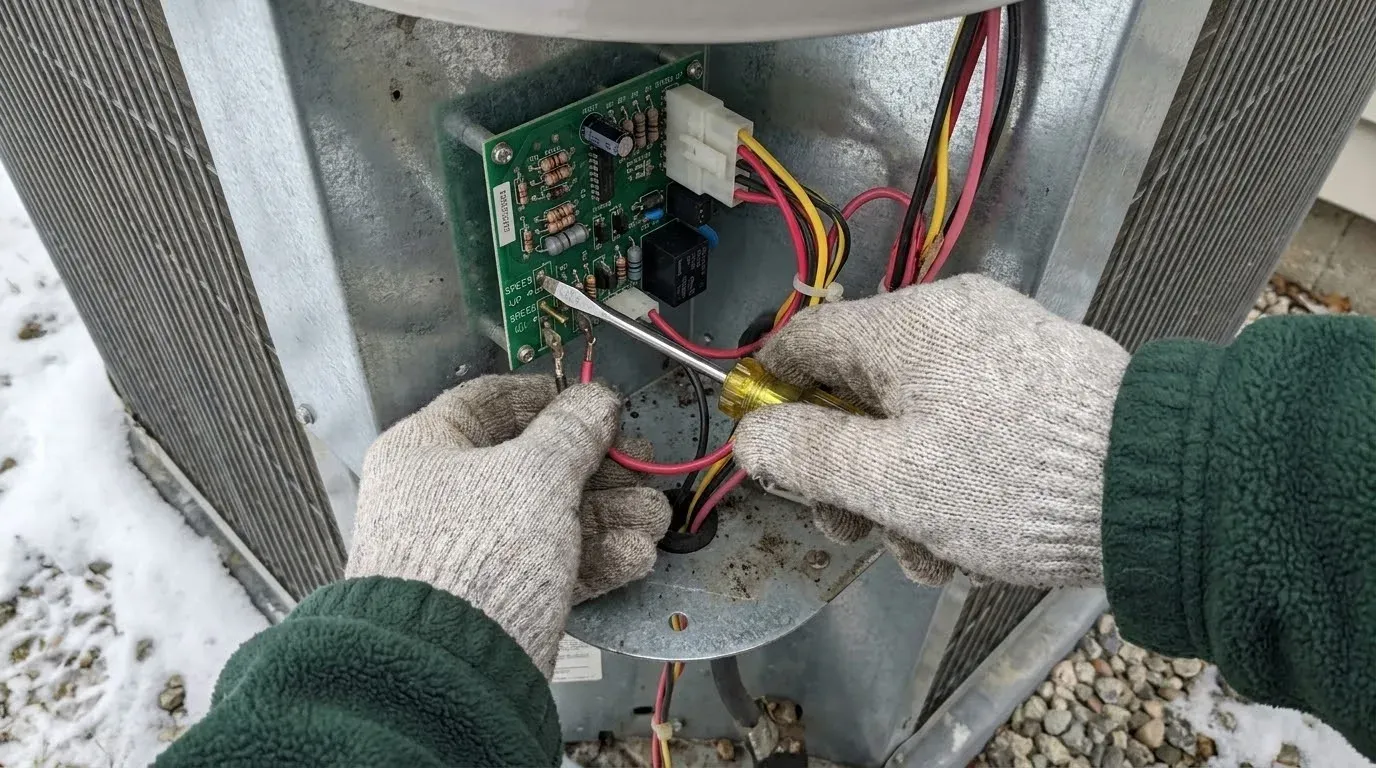
A technician tests this by forcing a defrost: on most boards, jumping a pair of test pins for a few seconds starts the cycle on demand. If the unit defrosts when forced, the board works, and the sensor is the next suspect, checked with a meter. If it will not defrost even when forced, the board is the problem. A defrost board runs $200 to $650 installed nationally, and HomeAdvisor’s range for a heat pump that will not defrost, diagnosis included, is $90 to $650.
Does it go into defrost but stay frozen?
This is the pattern that most often ends in a refrigerant diagnosis. The fan stops, the valve whooshes, the cycle runs its full length, and the coil comes out of it still white. Defrost works by pushing hot refrigerant through the outdoor coil, and a system that is short on refrigerant does not have enough hot gas to melt the ice. The same shortage makes the coil run colder in heating mode, so it frosts faster too.
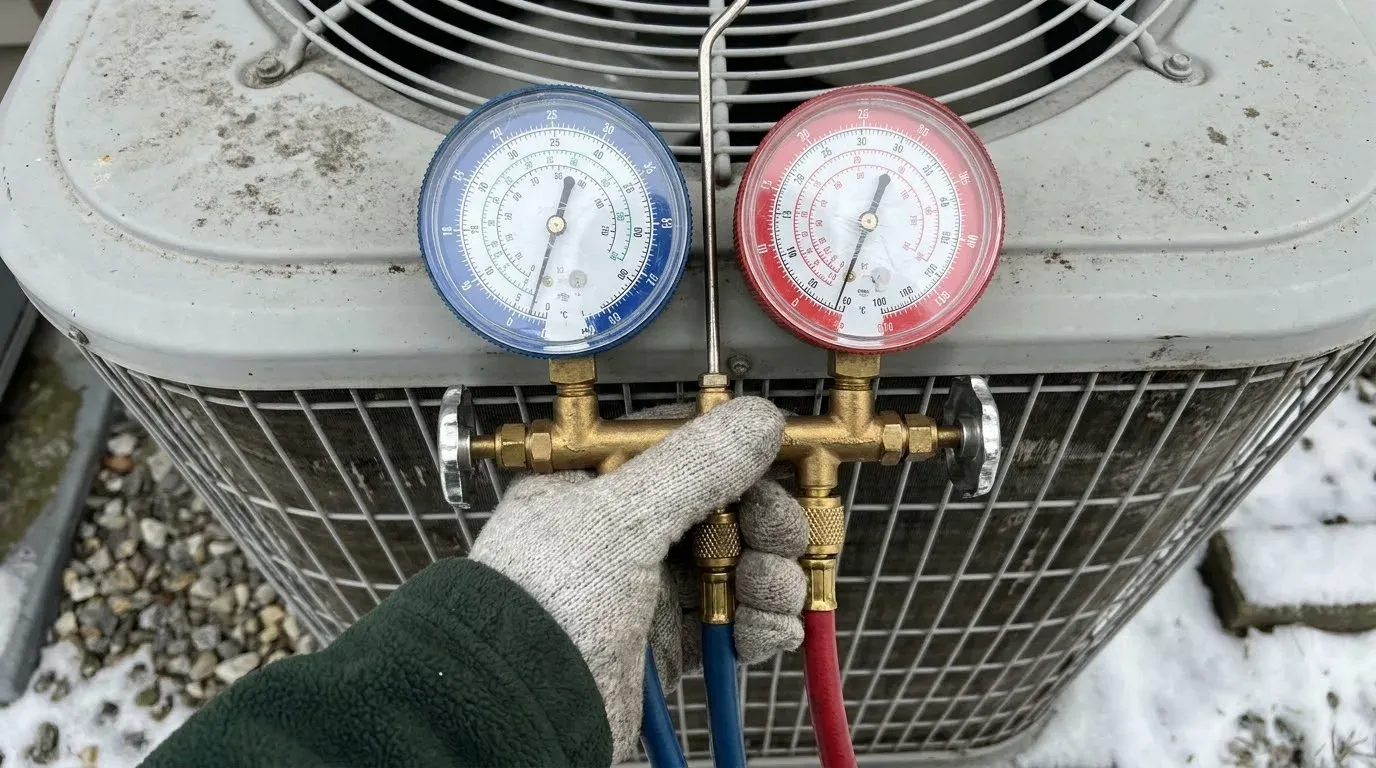
A technician confirms it with gauges, checking the pressures against the manufacturer’s heating chart for the indoor and outdoor temperature. Two things are worth knowing before that visit:
- Low refrigerant means a leak. Refrigerant runs in a sealed loop and is not used up. A system that needs some has lost it somewhere, and the honest fix is to find the leak: oily spots on the coils and fittings first, then an electronic detector, then a nitrogen pressure test if needed.
- It is regulated work. The EPA requires Section 608 certification to add or remove refrigerant. Refrigerant itself runs $100 to $350 nationally, and a leak in the outdoor coil can mean a new coil at $650 to $1,500. Our AC not cooling guide covers what a leak repair costs and when it stops being worth it.
A stuck reversing valve can look similar: the fan stops, but the system never really switches over, so no hot gas reaches the coil. It is less common, and the technician will rule it out with the same gauges.
A check you can do yourself: the temperature at the vents
You can tell whether the heat pump is really heating with a kitchen or pocket dial thermometer. Set the thermostat a couple of degrees above room temperature, wait ten minutes, and hold the probe in a supply vent near the air handler.
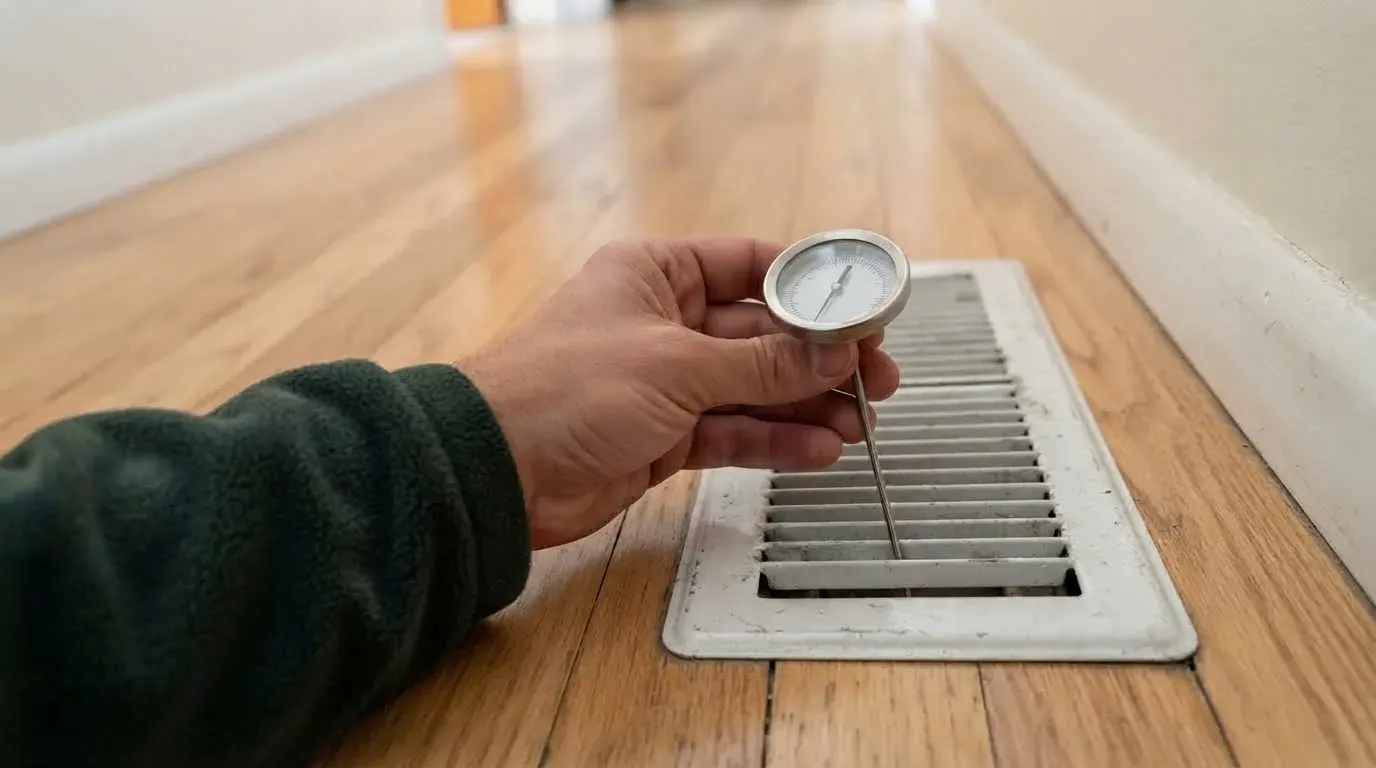
A heat pump running on its own, without the backup strips, usually delivers air about 20 degrees warmer than the room: around 90°F with the house at 70°F. If the air is only 5 to 15 degrees warmer, the heat pump is not moving enough heat, and a low charge is the usual reason. Two cautions make the test fair. Read it when the backup heat is off, because heat strips push the vents past 100°F and hide the problem. And do not read it during a defrost cycle.
Write the number down. It is exactly what a technician will want to hear on the phone.
Frozen in summer is a different problem
Ice on a heat pump in July, on the indoor coil or on the large copper line, is the cooling-mode problem air conditioners get, and it comes from dirty filters and low airflow far more often than from the defrost system.
AC Not Cooling? 7 Causes and How to Fix Each (2026) Ice in cooling mode? The fixes for a frozen indoor coil are in the AC guide.When to stop and call
Book a yearly check before the heating season as well. A technician who tests the defrost board, the sensor and the charge in October is far cheaper than an emergency call on the coldest night in January.