A central air conditioner is two machines that have to agree: the indoor unit (a furnace or an air handler) with the thermostat wired to it, and the outdoor unit with the compressor. A 24-volt control circuit from the indoor side tells the outdoor side when to run. When nothing comes on, the fastest way to the fault is to find which of those pieces is dead, because each one has its own short list.
- National average AC repair, June 2026
- $417
- What a troubleshooting visit costs before any part
- $75–$180
- Typical low-voltage fuse on a furnace or air handler board
- 3–5 A
- Restart delay a utility load-control switch can add
- 5–10 min
Repair prices: HomeAdvisor central AC repair data, updated June 17, 2026. Load-control delay: Town of Apex, NC electric utility.
Which half is dead?
Set the thermostat to Cool, a few degrees below the room temperature, and fan on Auto. Then look at three things: the thermostat screen, the indoor blower, and the outdoor unit.
The thermostat and the control circuit
Is the thermostat actually asking for cooling?
A blank screen on a battery thermostat is almost always the batteries. Replace them with a new pack, not loose ones from a drawer: check the date printed on them, because a set that expired years ago reads as dead as an empty one. If the screen comes back, confirm the mode says Cool rather than Heat or Off, and that the setpoint is at least 3 degrees below the room.
A thermostat with no batteries runs on power from the furnace or air handler, through its C wire. If that one goes blank, the thermostat is not the problem: it has lost the 24 volts the indoor unit supplies, which brings you to the next check.
Has the low-voltage fuse or board breaker tripped?
The indoor unit has a small transformer that makes the 24 volts for the thermostat and the outdoor contactor, and the control board protects it with a fuse. On most boards it is a 3- or 5-amp automotive blade fuse; newer furnaces and air handlers use a push-button resettable breaker marked 3 AMP instead.
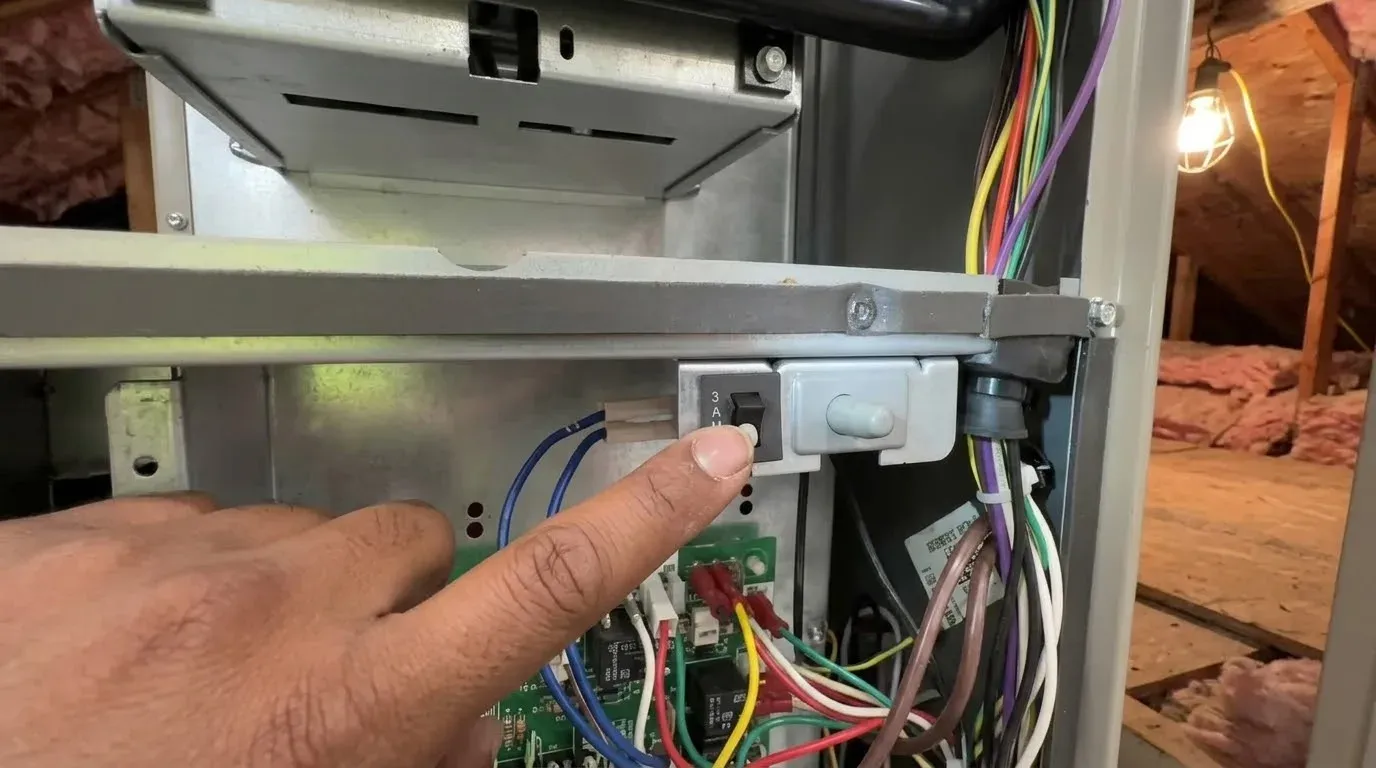
Turn off the switch on the side of the furnace or air handler, remove the blower door and look at the board. A blown blade fuse has a dark mark or a broken strip in its window: replace it with the same rating. A tripped resettable breaker sits out further than when set: press it in. Put the door back firmly, because a door switch behind it cuts all power until the panel is seated, and that alone stops many systems after a filter change.
A replacement fuse that pops too means a short in the thermostat wiring. The usual spots are where the thin cable runs outside to the condenser: a string trimmer at the base of the unit, a rodent in the crawl space, or a cable pinched under the outdoor unit’s cover. The fuse costs a few dollars; the wire is what needs fixing.
Water in the drain pan
Has the condensate safety switch shut the system down?
An AC wrings gallons of water a day out of humid air, and it leaves through a PVC line. Algae and dust plug that line over a summer. To stop an overflow, most air handlers in attics, closets and garages carry a float switch in the pan or a wet switch on the line. When the water rises, the switch opens the 24-volt circuit and the cooling stops. Some systems keep the indoor fan running when this happens; others shut everything off.
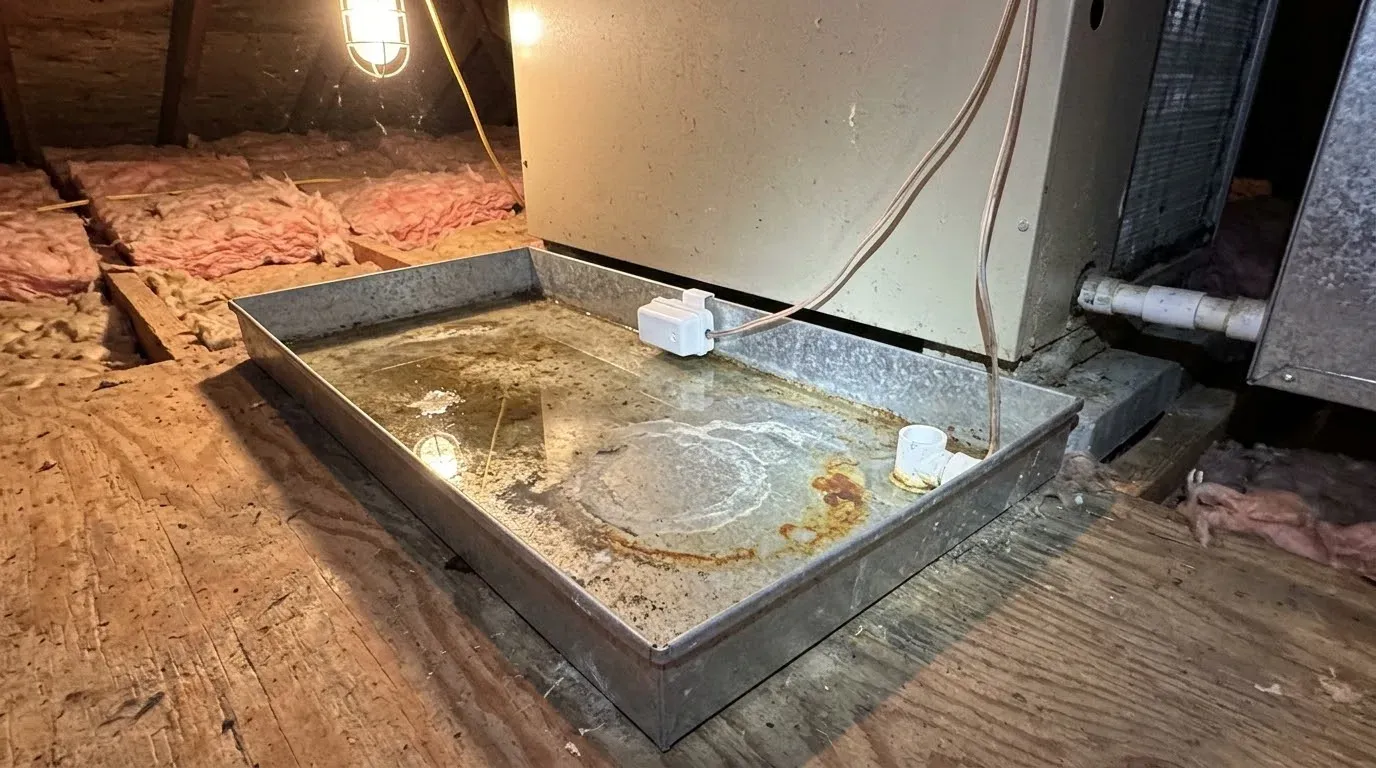
Look for water in the pan, a wet switch with its red light on, or a condensate pump that has stopped. To clear the line, find where it ends outside or at a floor drain, seal a wet-dry vacuum over the end and pull for a minute. Pulling is safer than blowing: pressure can push apart a glued joint inside a wall or ceiling. When the clog lets go, a rush of water comes out, the float drops and the cooling restarts within a few minutes. Pour a cup of water into the line’s trap opening, if it has one, before you run the system again, and empty the pan.
A condensate pump that hums but does not pump, or is silent with a full reservoir, has failed. It plugs into an outlet and its safety switch connects with two wires, so replacing it like for like is within reach for many homeowners.
Power to both units
Has a breaker tripped?
A split system has two circuits in the panel: a 120-volt breaker for the furnace or air handler, and a 240-volt double-pole breaker for the outdoor unit. A tripped breaker often rests in a middle position that looks almost on. Move each handle hard over to Off, then to On; a breaker that only looks fine has not been reset until it has gone all the way off.
A breaker that flips back the moment the unit tries to start is not a reset job. A shorted compressor or fan motor, or a failed capacitor, can trip a breaker on every start, and repeated resets stress the part and the breaker.
Is the outdoor disconnect pulled or switched off?
The gray box mounted on the house next to the outdoor unit is its service disconnect: a pull-out block, a lever, or a pair of fuses. Painters, landscapers and technicians pull it and forget. Many pull-out blocks are printed ON on one side and OFF on the other, and slide in either way: if it reads OFF, it was put back backwards.
Turn off the outdoor breaker in the panel before you reinsert or flip anything, then turn the breaker back on. Look inside the box for scorch marks or a melted block while it is open: either one is a call. A fused disconnect with a blown fuse is also a sign that something in the outdoor unit drew too much current.
Indoor fan runs, outdoor unit silent
Is the contactor pulling in?
The contactor is the relay in the outdoor unit that the thermostat’s 24 volts close to send 240 volts to the compressor and fan. Its state tells you which side the fault is on. With the thermostat calling for cooling, a technician (or you, looking through the service panel opening without touching anything) can see whether its center plunger has pulled in.
- Plunger pulled in, unit silent or humming. The call for cooling is arriving. The usual cause is a failed run capacitor; on a bad one the top is often domed or leaking, and the compressor hums for a few seconds then stops. It is a $120 to $475 repair nationally, and the hum, click and nudge symptoms of each part are laid out in why an AC runs but does not cool.
- Plunger out. The 24-volt signal is not getting there. Go back over the fuse, the drain switch, the door switch and the thermostat wire, then the pressure switches below.
Never push the plunger in by hand or with a stick to “test” the unit: the terminals around it carry 240 volts, and forcing a compressor to start against a failed capacitor can damage it.
Has a refrigerant pressure switch tripped?
Many outdoor units carry safety switches on the copper lines, wired into the 24-volt circuit so they can stop the contactor from closing. A low-pressure switch sits on the larger, insulated suction line; it opens when refrigerant runs low, usually from a leak. A high-pressure switch sits on the smaller liquid line; it opens when the unit overheats, most often because the condenser coil is caked with grass, dust and cottonwood fluff, or the outdoor fan has stopped.
The part you can do is the coil. Disconnect pulled first, then rinse the fins with a garden hose from the inside out where you can, so the dirt leaves the way it came in. A pressure washer bends the soft aluminum fins and blocks more air than the dirt did. Some high-pressure switches reset on their own once things cool; others latch until the power is cycled. A low-pressure trip is a refrigerant leak until proven otherwise, and only an EPA-certified technician can find it and recharge the system.
It went off and will not restart yet
Is a restart delay holding it off?
A compressor that stops cannot restart right away against the pressure still in the lines, so most thermostats and many outdoor control boards build in a delay, often around five minutes, after any shutdown, a power blink or a setting change. Some thermostats show “wait” or a flashing snowflake while it counts down.
Utilities add a second one. Homes enrolled in a demand-response or peak-saver program have a load-control switch on or near the outdoor unit, often with a small indicator light. After a power cut it holds the compressor off for a set time; one North Carolina utility tells contractors its switches wait 5 to 10 minutes. During a peak event the switch may cycle the compressor off for longer. If you never signed up, a previous owner may have; the utility can tell you.
AC Not Cooling? 7 Causes and How to Fix Each (2026) If the AC does come on but the house stays warm, the causes and the order to check them are different.Faults to hand to a technician
A visit that starts with “thermostat set, both breakers reset, drain clear, contactor pulled in” usually ends with one part and one bill. If the unit is past 12 to 15 years and the bill is for the compressor or a leak rather than a $20 part, weigh it against the repair-or-replace thresholds for central air before you approve it. A spring maintenance visit measures the capacitor and looks at the contactor before they fail on the hottest day.