A water heater making noise at night, rumbling or popping or ticking, sounds like it is about to give out. Usually it is not. Each noise has a short list of causes, most of them harmless, and the sound itself tells you which list you are on.
Plumber Roger Wakefield says noise calls come in a lot, and most turn out not to be a big deal. The trick is to match the sound to its cause, then check the two or three things that would make it serious.
- How often to flush a tank, from the day it is installed
- 1×/year
- Typical thermostat range, which keeps a tank well below boiling
- 110–125°F
- Highest static house pressure the plumbing code allows
- 80 psi
- Where a standard T&P relief valve opens on temperature
- 210°F
Sources: two plumbing walkthroughs by Roger Wakefield (Plumbing 101), a water heater noise video by SOS Accessoire, the International Residential Code, and Watts T&P valve specifications.
Which noise is it?
Before you go hunting, stand next to the heater while it runs. Wakefield’s advice is simply to get close and listen, because most noises have an obvious source once you are a foot away. For a sound you cannot place, he suggests a cheap mechanic’s stethoscope from an auto parts store: press it against the tank, the pipes and the valves in turn, and the noise gets loud at its source.
Rumbling, popping or boiling: sediment
This is the noise that scares people most, and the most common one. Wakefield describes it as a train rolling around inside the tank, or a stomach growling in the middle of the night.
Hard water carries calcium and magnesium. As the tank heats, those minerals drop out and settle on the bottom as a crust. Water gets trapped under and inside that layer, and when the burner or the lower element heats it, it flashes to steam and bursts up through the sediment. That is the pop, and a steady run of pops is the rumble. The water in the tank is nowhere near boiling at a normal 110 to 125°F setting; only the pockets trapped under the scale are.
On an electric heater, the scale also builds up on the lower element itself. SOS Accessoire’s technician, showing the same problem on a European tank, cleans a lightly scaled element with vinegar and replaces one that is too far gone. On a US tank that is a $200 to $400 element job if you have it done, the same range as in our no hot water guide.
Sediment also costs money. Wakefield’s point is that the burner has to heat through all that scale before it heats the water, so the tank wastes energy and takes longer to recover.
Popping right as a gas burner lights can have a second cause. Wakefield mentions debris, or even a bug, falling down the flue onto the burner and burning off. That kind of popping stops on its own once it has burned away.
How to quiet it: flush the tank
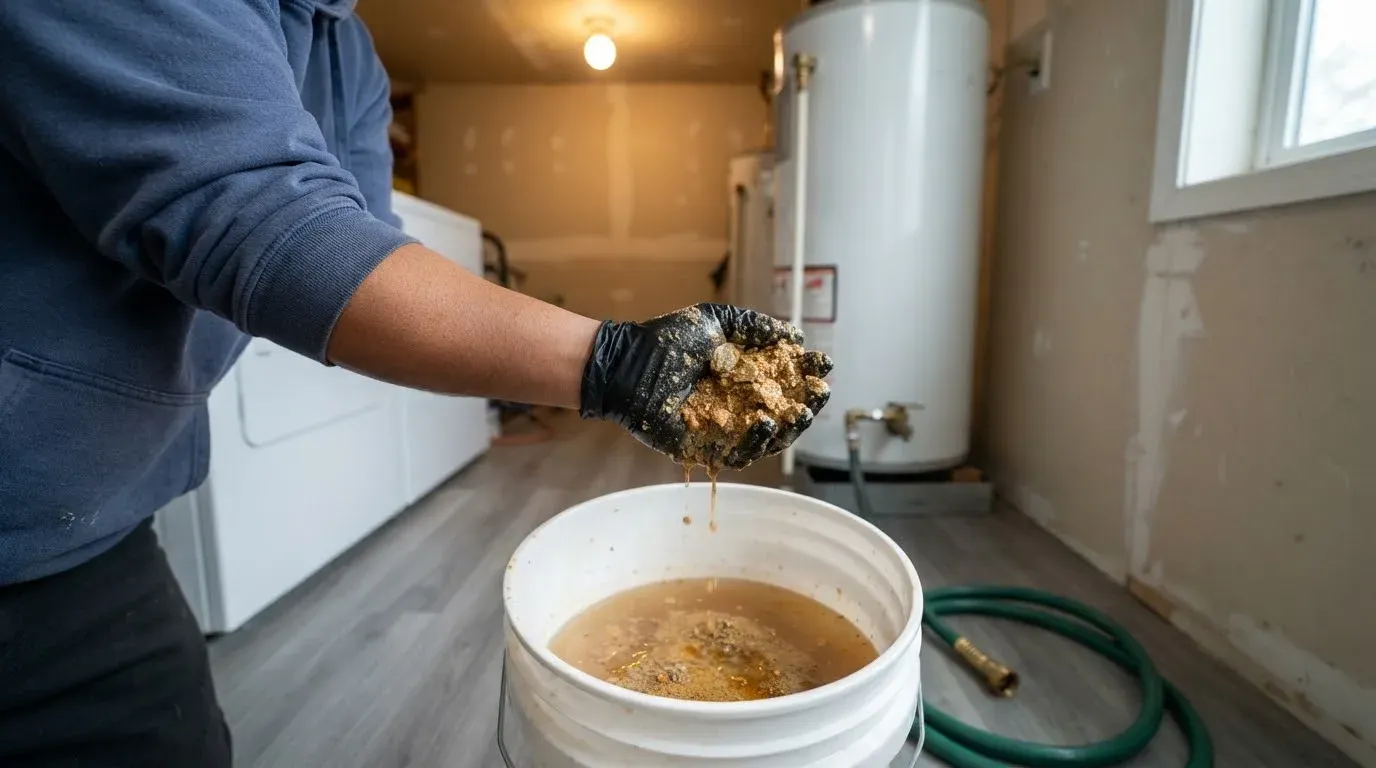
Flushing means draining water out through the drain valve at the bottom until it runs clear, which carries the loose sediment out with it. Turn off the gas or the breaker first, close the cold supply, connect a garden hose to the drain valve, open a hot tap somewhere in the house so air can get in, then open the drain. Opening the cold supply for a few seconds near the end stirs up the bottom and pushes out more.
Both Wakefield videos come down to the same habit: flush once a year, starting the year the heater is installed. He adds a caution for old tanks. On a heater about four years or older that has never been flushed, he says he would probably leave it alone. He does not say why in the video; the risk plumbers usually point to is an old drain valve that will not seal again once it has been opened, so know where the cold shutoff is before you try. A tank that has been flushed most years and missed a couple is different: answering a viewer with a nine-year-old tank on well water, he says to resume.
A “self-cleaning” tank does not get you out of it. The inlet on those sprays across the bottom to keep sediment moving so more of it leaves through your taps, but it does not stop the layer from building up.
Wakefield also recommends replacing the anode rod after the first year. The rod corrodes on purpose so the tank does not, and he says a fresh one can sometimes double the life of a water heater. Treat that as one plumber’s experience rather than a figure you can bank on, but it is a cheap part next to a new tank.
If a tank keeps rumbling after a good flush, it is usually old and heavily scaled. Look at the age on the rating plate before you spend money on it, and see what a replacement really costs.
Sizzling or crackling: condensation on the burner
On a gas heater, burning gas makes water vapor, and the flue that carries it out runs up through the middle of the tank. When that vapor meets a cold flue, on a cold or rainy day or after a long shower has filled the tank with cold water, it condenses and drips back down onto the hot burner.
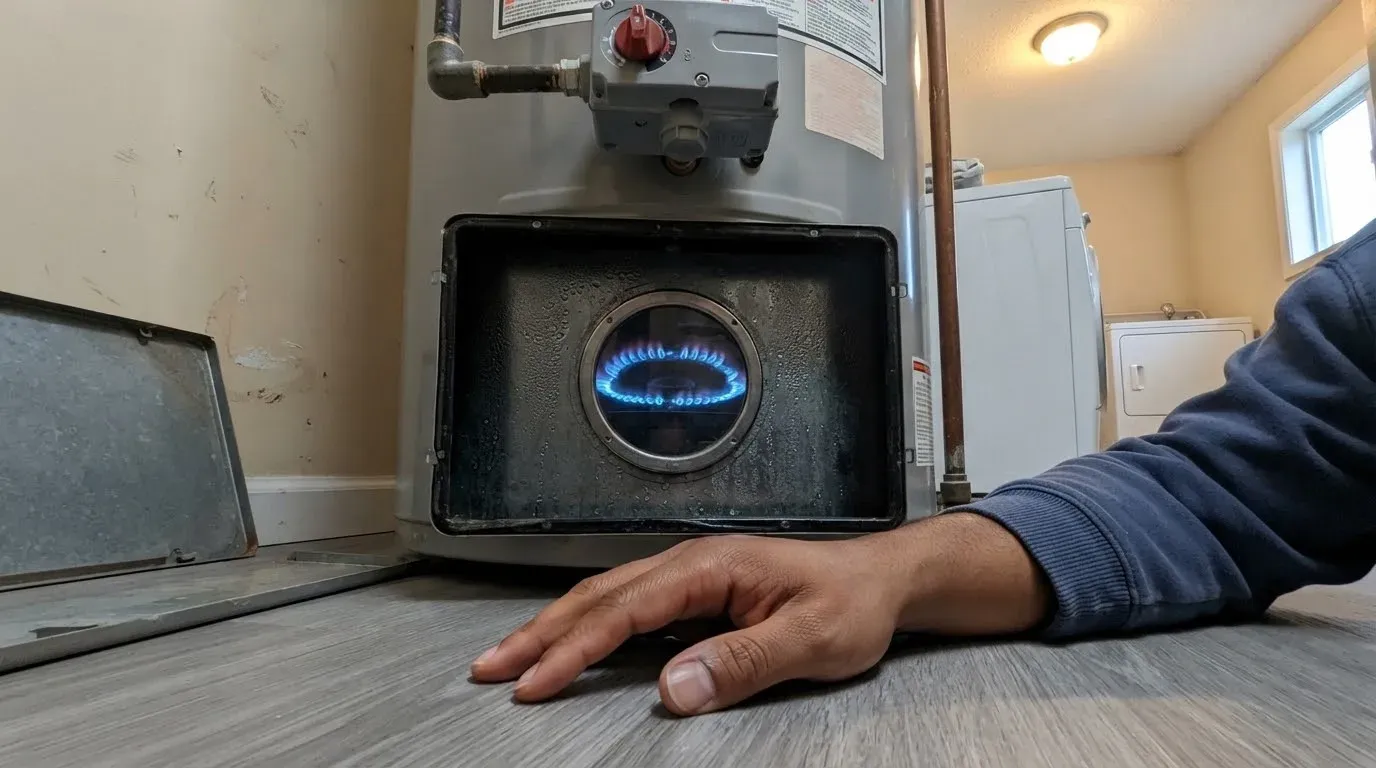
Wakefield compares it to flicking water on a hot skillet to see if it is ready, which is exactly the sound you hear. You may hear it at the top of the tank as well as down at the burner. It is normal and it stops once the tank is warm.
Two things change that. If the sizzling goes on long after the tank is hot, or there is water under the heater, it is no longer condensation: work through the checks in our leaking from the bottom guide. And sizzling right after the burner shuts off on a rainy day can be rain coming down the vent, which is worth a look at the vent cap on the roof.
Ticking or tapping: expansion
Metal grows as it heats and shrinks as it cools. The tank does it, and so do the copper pipes leaving it, and the result is a slow tick, tick, tick that speeds up and fades away. It happens on gas and electric heaters alike.
Wakefield hears it in his own house: when he turns on the hot water to shave, he can tell the hot water is on its way by the ticking of the copper in the wall behind the bathroom. It is common enough that he says it is one of the two noises that worry homeowners most, along with rumbling.
The one ticking worth checking is a steady, drip-like tick inside a wall when nobody in the house is running water. Expansion only happens when hot water is moving or a pipe is cooling down. If the tick keeps going with every tap closed, look along the baseboards and on the other side of that wall for damp before you put it down to expansion.
Humming: an electric element at work
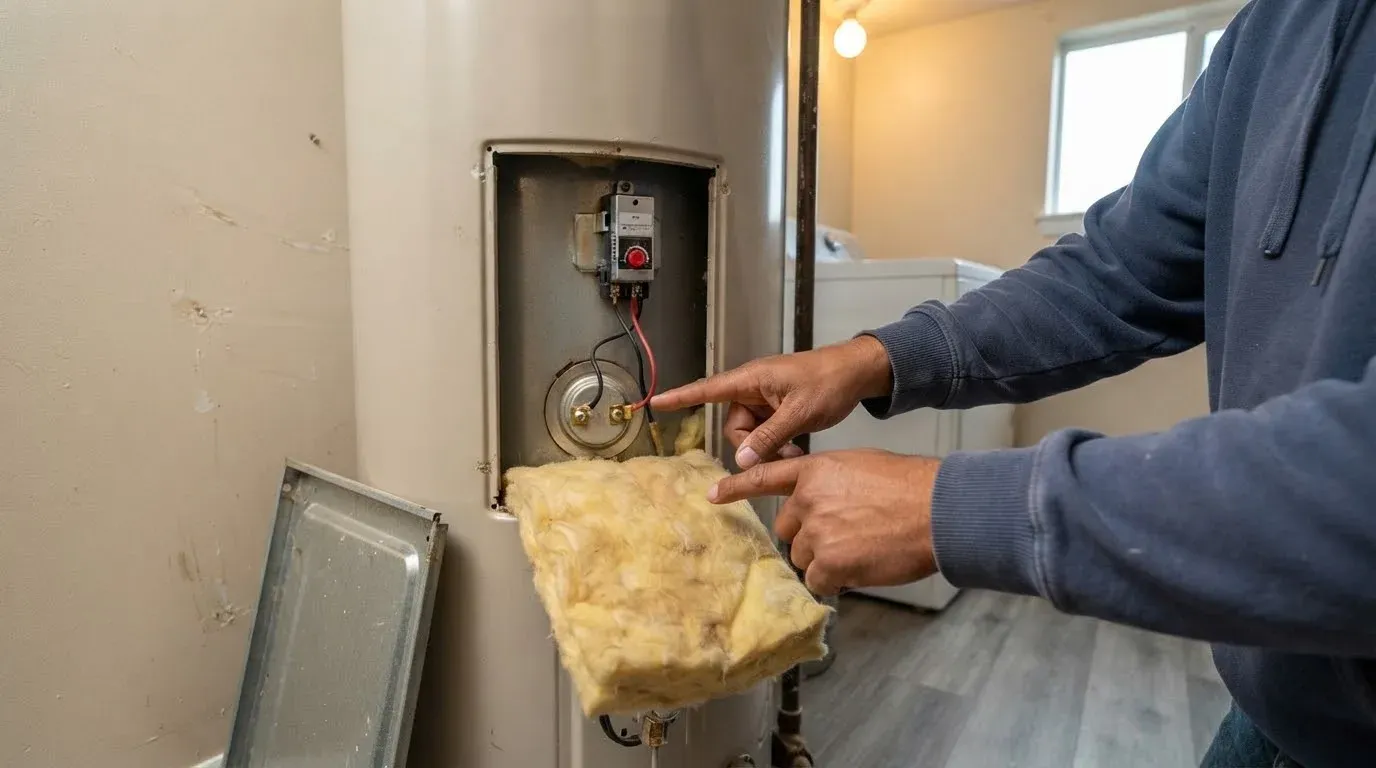
An electric tank heats with one or two elements screwed through the tank wall behind the access panels. When a thermostat calls for heat and the element switches on, a low hum is normal, which is the water around it starting to heat.
A hum that is louder than it used to be, or comes with a buzz or a whistle, can be a loose element. Wakefield’s advice is to check that elements and valves are snug, and to replace an element that has worked loose inside the tank. That means draining the tank below the element, and the terminals carry 240 volts, so switch off the breaker first and treat it as a job for someone who has done it before.
Hissing: insulation, condensation or a leak
On an electric heater, hissing often comes from the panels. Each one covers a thick pad of insulation, and after a repair that pad is easy to leave pushed to one side. Wakefield’s point is that it all needs to go back: without it, cold air gets in against the warm tank, condensation forms around the element and the thermostat, and you hear it hiss as the tank heats.
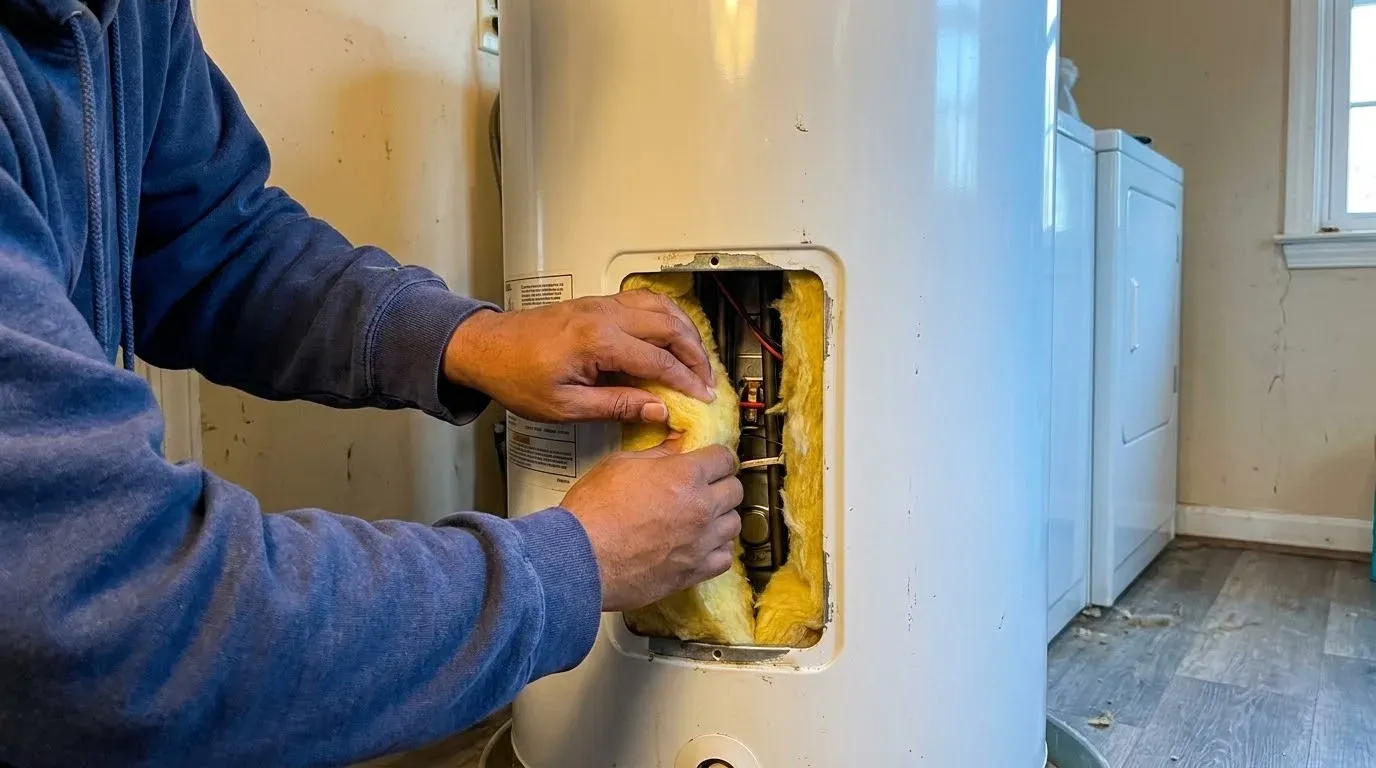
The same hiss can also mean a real leak. Expansion and contraction can open a small seep where an element passes through the tank wall, and on a gas heater a leak dripping onto the burner sounds just like condensation. Wakefield’s check is the same in both cases: with the power or the gas off, take off the covers and shine a flashlight inside. There should be no water in there at all. Finding a seep this way, before it reaches the floor, is the cheap way to find it.
A hiss or whistle from the T&P relief valve on the side or top of the tank is different again. That valve opens to release pressure or overheated water, so a discharging T&P is covered in the leak guide, along with what to do about high pressure.
Whistling, whining or screeching: a restricted valve
A high-pitched whistle usually comes from water being squeezed through a gap that is too small.
The first suspect is the cold inlet valve on top of the tank. If it is partly closed, or it is an old gate valve whose gate has worked loose, water forces past it and whistles. Wakefield says those old gate valves should be replaced with a full-port ball valve anyway: he has had gates close inside the valve and stick, which leaves you unable to shut the water off when you need to.
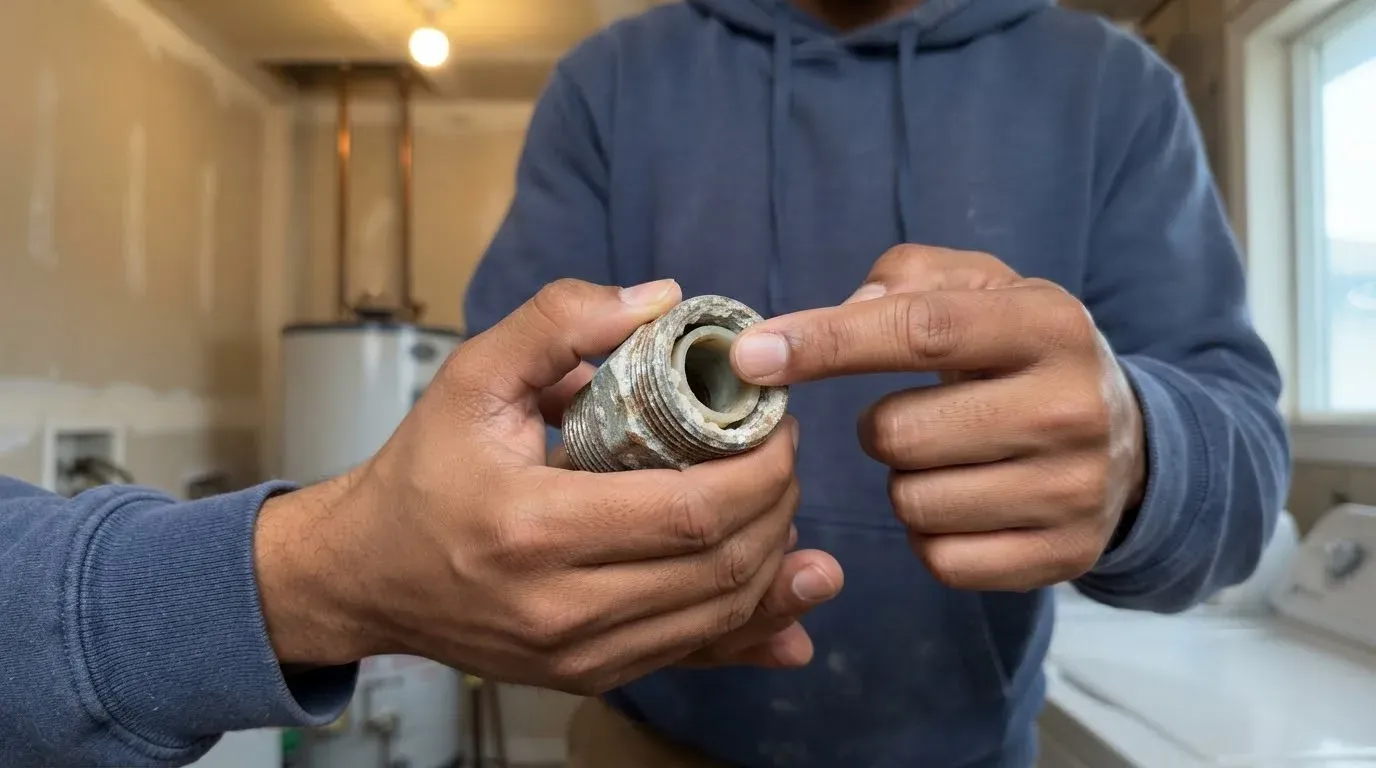
The second is the dielectric nipple, the short fitting that joins the tank to the house pipes and keeps two different metals apart. Some have a narrowed bore, and in one of the videos Wakefield’s team pulled a nipple out of a tank because so much water was rushing through it that it screamed. On some brands the anode rod is built into the hot outlet nipple, which is another part that can sing. Both can be replaced.
Banging or knocking: water hammer
A bang in the pipes right after a faucet, a washing machine or a dishwasher shuts off is water hammer. The water was moving, the valve stopped it dead, and the shock wave slams through the pipes. The heater is often blamed because it is where the pipes are easiest to hear.
The cure is a water hammer arrestor, a small cushioned fitting installed near the valve that closes fast. Both Wakefield and the SOS Accessoire technician point to it as the fix. The SOS video adds the second half: if your house pressure is too high, a pressure-reducing valve takes the force out of every shut-off. The plumbing code caps static house pressure at 80 psi (IRC section P2903.3.1), and a $10 gauge on a hose bib tells you where you stand.
Water Heater Leaking From the Bottom? Find the Source Fast Noise and water under the tank? Find where the water starts before you call anyone.When a noise means calling someone
Everything else on this page, a homeowner can check with a flashlight and five minutes of listening.