A short cycling furnace goes through its whole start-up, makes heat for a while, then shuts the burners off before the thermostat is satisfied and starts over. The part that stops it is almost always a safety switch doing its job, so the fix is to find what that switch is reacting to. The moment in the cycle when the burners go out narrows it down to one or two causes.
- Heating cycles an hour a gas furnace thermostat is usually set for
- 3–5
- Slope a condensing furnace vent needs, back toward the furnace
- ¼ in/ft
- A flame sensor replaced, if cleaning does not fix it
- $150–$250
- National average furnace repair, June 2026
- $318
Repair prices: HomeAdvisor national furnace repair data, updated June 2026. Vent slope: condensing furnace installation manuals.
Watch one full cycle and note where it stops
Every gas furnace starts in the same order, and each step has to prove itself before the next one runs. The thermostat sends 24 volts to the control board on its W terminal. The inducer fan starts and pulls air through the burners and out the vent, and the pressure switch closes once it senses that draft. The ignitor glows orange, the gas valve opens, and the flame sensor has a few seconds to confirm a flame. After a short delay that lets the heat exchanger warm up, the main blower comes on.
Set the thermostat a few degrees above room temperature and watch through the sight glass or with the burner door off, keeping clear of the burners. Note what is running when it stops, and how long it ran.
Most boards retry three or four times after a failed light, then lock out, often for an hour, before trying again. Count the blinks of the status light before you cut the power, because turning the furnace off clears the code. The chart that decodes the blinks is printed on a label inside the furnace panel.
The causes, from the cheapest fix up
A clogged filter is overheating the heat exchanger
The blower’s job during heat is to carry the heat off the exchanger. Starve it of air and the exchanger gets hotter than it was built for within minutes, the high-limit switch opens, and the gas valve closes while the blower carries on to pull the heat away. Once the switch resets, the burners light again and the loop repeats. Closed supply registers, a blocked return grille and a dirty blower wheel cause the same thing.
Pull the filter and hold it to a light. If you cannot see through it, replace it with the size printed on its frame, airflow arrow pointing at the furnace. Then open every supply register in the house and clear anything stacked against the return grilles. If the cycling stops the same day, that was the whole job.
The flame sensor is coated and cannot prove the flame
The flame sensor is a thin metal rod set in the flame of the burner farthest from the ignitor. The board sends a small AC voltage down it, and the flame turns that into a tiny DC current back through the burner and the chassis ground. No current, and the board closes the gas valve. Soot, rust or a white oxide film on the rod act as an insulator, so the burners light, run for a few seconds and go out, even though you can see a good flame.
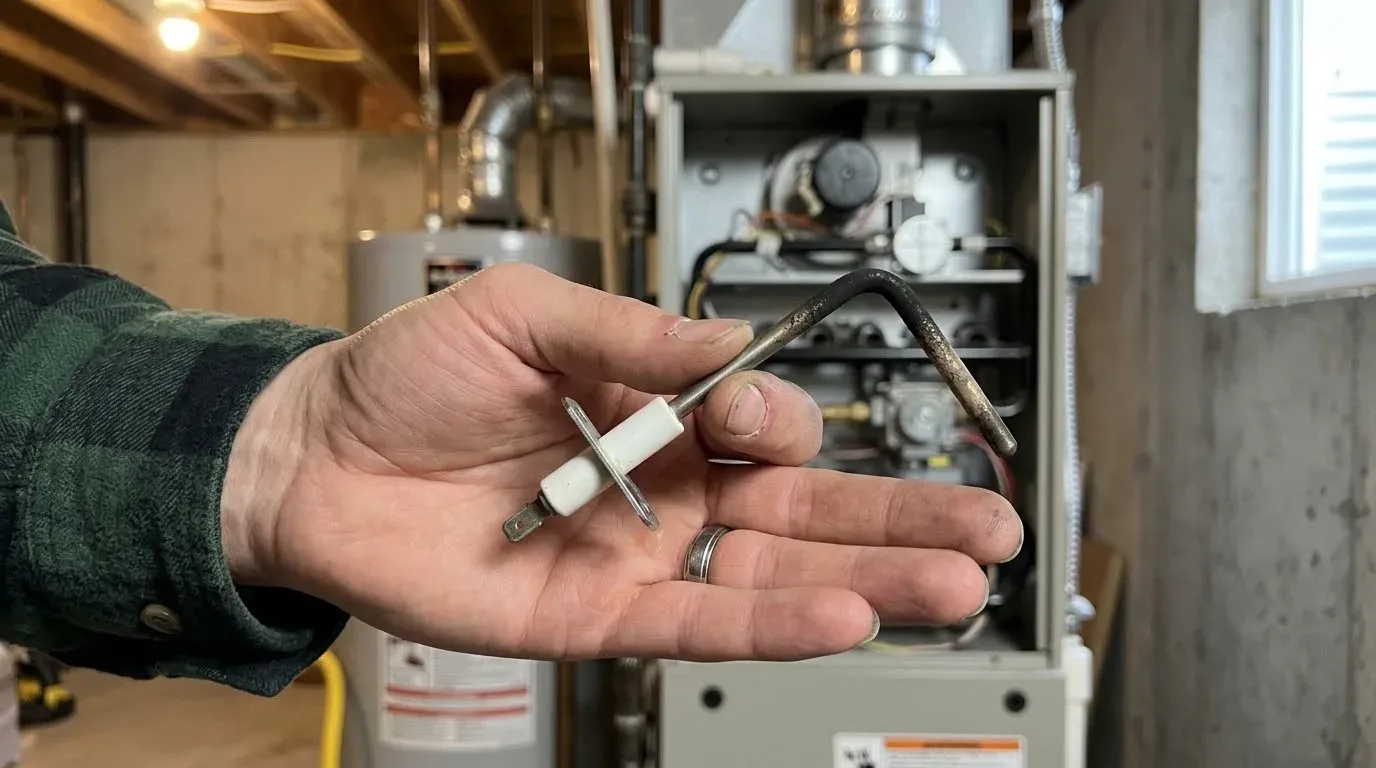
Turn the furnace off at its service switch first: the rod carries voltage while the furnace is powered. Remove the single screw, slide the sensor out and rub the rod with plain steel wool or a fine abrasive pad until it is bright. A soapy scouring pad leaves residue, so if that is all you have, wipe the rod clean afterward. While it is out, check three things that cause the same symptom: the white ceramic insulator must not be cracked, the wire must be tight on its terminal, and the green ground wire must be tight and rust-free where it bolts to the cabinet.
Put the sensor back so the rod sits in the middle of the flame and does not wobble. If the burner faces are rusty, rub them lightly too. The first light after cleaning may show orange streaks for a minute: that is dust you knocked loose burning off. A sensor that is clean, tight and grounded but still drops out needs replacing, $150 to $250 installed nationally.
The high-limit switch trips with a clean filter
The limit switch is a bimetal disc behind the burners or on the supply side that opens at a set temperature. Its rating is often stamped on the face: one marked L200-40 opens at 200°F and closes again 40 degrees lower, at 160°F. Ratings of 180°F to 220°F are typical.
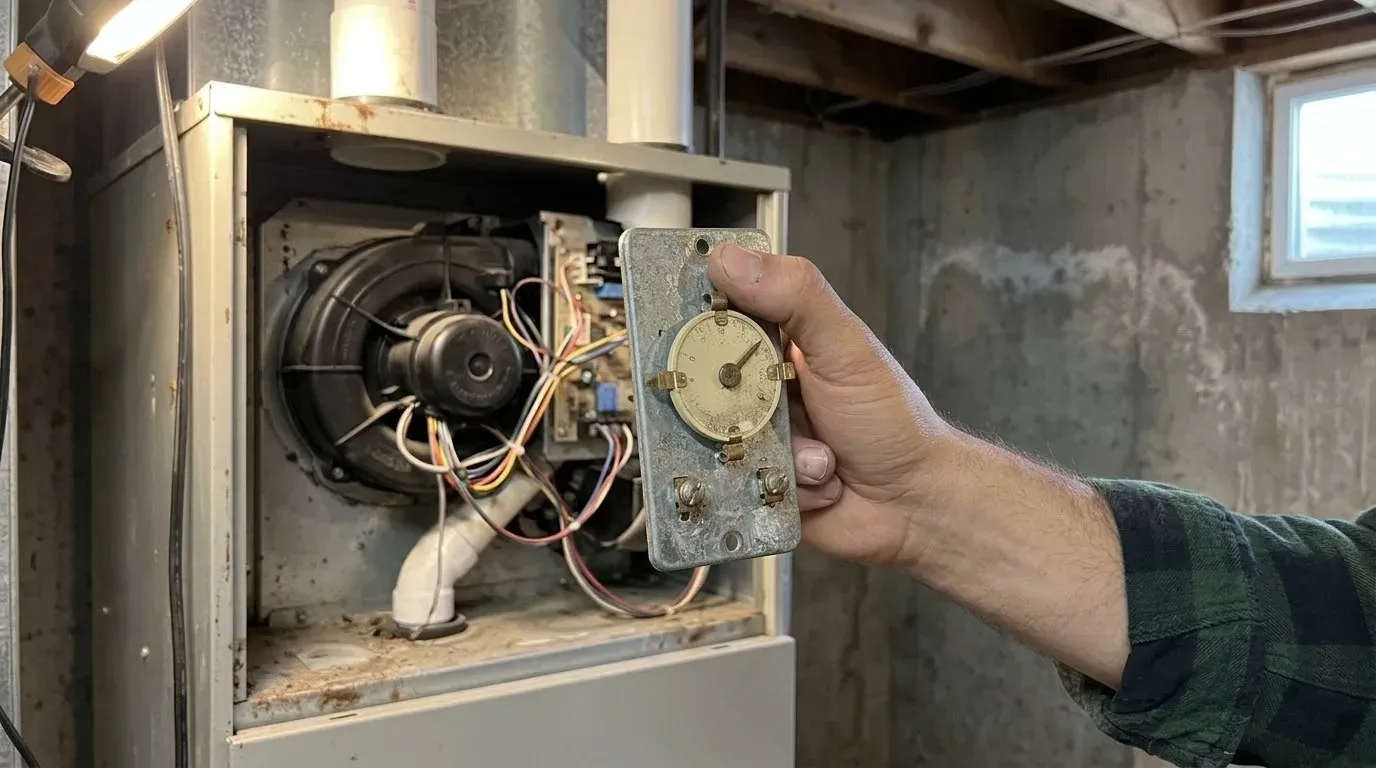
If the filter is new and the registers are open, the question is whether the furnace really overheats or the switch has gone weak. A probe thermometer answers it. After 10 minutes of heat, read the air in the return duct and in the supply duct a few feet from the furnace. Air going in at 70°F and leaving at 120°F is a 50-degree rise. Compare it with the temperature-rise range on the furnace’s rating plate. A rise above that range means real overheating: a blower set on too low a speed, a weak blower motor, ducts too small for the furnace, or a gas valve set too high, which a technician checks with a manometer at the valve outlet. A rise inside the range with the switch still tripping means the switch itself is failing. Nationally, a replacement runs $150 to $300.
Look at the flames when the blower starts. If they lean, flicker or roll out of the burner box at that moment, air from the blower is getting into the fire side, a sign of a cracked heat exchanger. Turn the furnace off and have it inspected before you use it again.
Water in the vent or the inducer is opening the pressure switch
On a 90% or higher furnace, the one with white plastic pipes, the pressure switch watches the draft the inducer fan creates. Its rating is tiny: often between 0.2 and 2 inches of water column, when 27.7 inches equal a single psi. So it does not take much to open it, and the switch is more often the messenger than the failed part. Many technicians name pressure switch problems as the most common cause of short cycling on these furnaces.
These furnaces pull so much heat from the exhaust that water condenses in the vent pipe. The pipe has to slope back toward the furnace at a quarter inch per foot so that water drains into the condensate trap. A run that sags in the middle collects a pool of it. The exhaust squeezes past for a few minutes, the draft weakens, the switch opens, and the furnace starts again a minute later. On a 20-foot run, one hanger that worked loose from a joist and let the pipe drop an inch or two is enough.
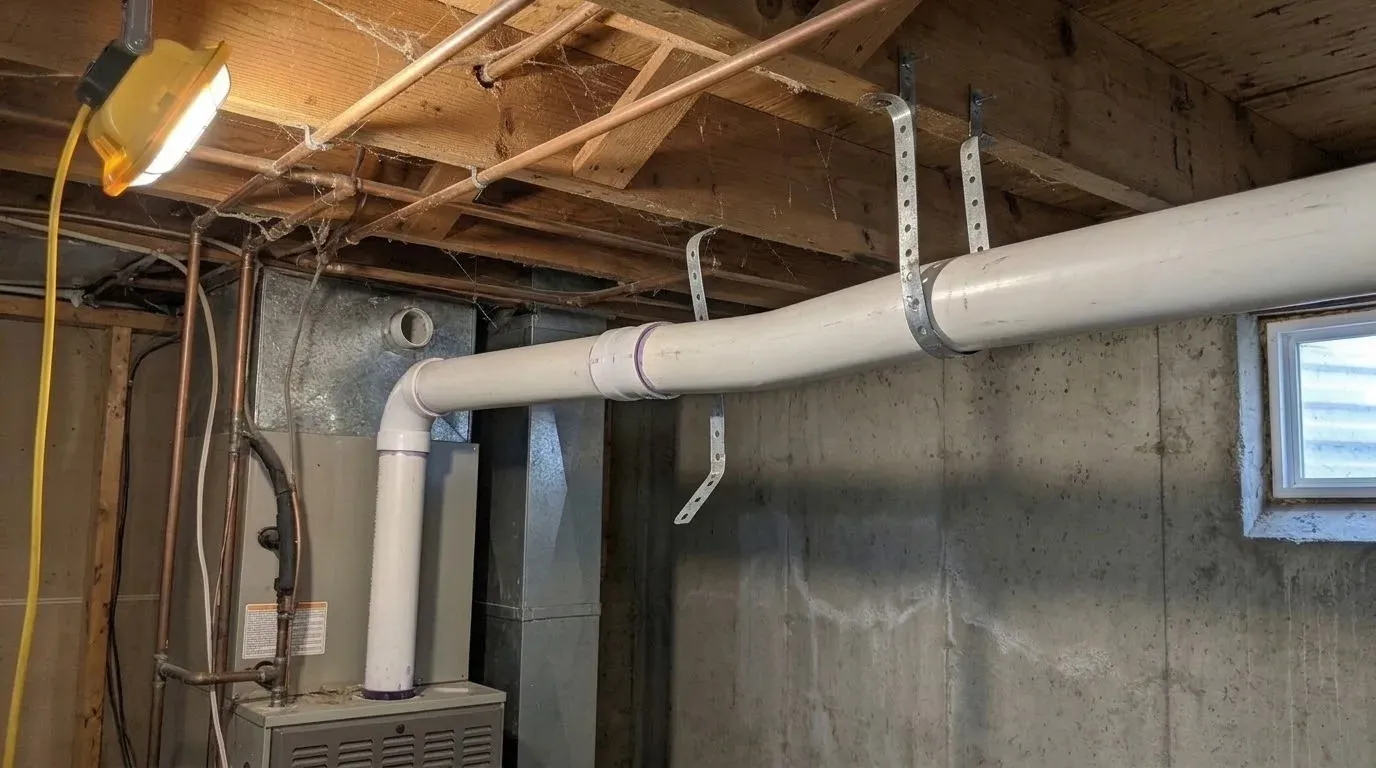
Sight along the vent from the furnace to the wall or roof. Any dip, or a section sloping away from the furnace, is suspect, and so is a hanger hanging by one side. Outside, check the vent and intake ends for a nest, leaves, snow or a frost plug. Clear what you can reach from outside; re-hanging or re-pitching the pipe is for the technician, because the joints carry exhaust. A gurgling inducer or water dripping from its housing points to a clogged condensate trap or drain instead, covered in our furnace leaking water guide.
Never blow or suck on the pressure switch hose to test it: your lungs can far exceed the switch’s rating and damage it. A technician tees a manometer into that hose and watches the reading through a full cycle. If the draft holds steady and the switch still opens, the switch is bad; if the reading dips just before the shutdown, the cause is in the vent, the drain, or an inducer wheel with broken blades.
The thermostat is cutting the call short
Here the furnace runs a normal cycle, just too briefly, because the thermostat thinks the room is warm. Check where it hangs: within reach of a supply register’s airflow, above a lamp or a TV, in afternoon sun, or on an outside wall, it reads high and ends the call early. Fresh batteries matter on models that use them, since a weak battery can drop the call.
In the installer menu, find the heating cycle rate. Gas furnaces are normally set for about 3 to 5 cycles an hour; a setting meant for electric heat allows up to 9. After a thermostat replacement, this setting and a loose wire on the W or R terminal are the two first suspects. An old mechanical thermostat with a heat anticipator dial needs that dial set to the current on its control circuit, usually printed on the furnace’s gas valve.
A loose spade connector or a worn relay on the board
When the furnace quits at random points with no pattern and no code, look for an intermittent connection. Furnace vibration loosens the push-on spade terminals over the years, and a connector that barely grips can lose contact for a second, long enough to drop the inducer or the gas valve. With the power off, wiggle each connector; a loose one can be crimped slightly tighter with pliers and pushed back on. The relays on the control board, under the small black covers, can also pit their contacts until they pass voltage only some of the time. Diagnosing that means reading the board’s outputs live at each step of the sequence, which is a technician’s test. A new board costs $200 to $600 installed.
The furnace is too big for the house
If every cycle is normal and every switch tests fine, but the furnace heats the house in a few minutes, shuts off and starts again soon after, it may simply be oversized. The US Department of Energy compares it to a car in stop-and-go traffic: frequent starts cut efficiency and speed up wear, and the house swings between too warm and too cool. Sizing is done with ACCA Manual J for the heat loss and Manual S for the equipment, not by floor area. A two-stage or modulating furnace that runs on low most of the time is the usual answer at replacement; until then, a lower cycle-rate setting lengthens each run.
Furnace Not Turning On? 10 Causes, Checked in Order (2026) If the furnace stopped retrying and stays off, work through the ten no-start causes in order.Shutdowns that need an HVAC visit
A technician who measures the temperature rise and the draft before replacing anything usually finishes in one visit; HomeAdvisor’s national range for a typical furnace repair is $133 to $505. Short cycling that started after a summer of dust is also what a fall furnace tune-up is meant to catch.